
When a woman you love is going through a major life transition, the fear you feel as a family member is real and specific. You are not just worried about where she will sleep tonight. You are worried about whether she will be safe. Whether she will be treated with respect. Whether the people around her will actually understand what she has been through and what she needs to move forward.
Those are the right questions to be asking. Because not every housing program is equipped to answer them well.
Hazel’s Tranquility Place was founded in 2019 by Fairfield Councilwoman K Patrice Williams specifically because she saw these needs going unmet in Solano County. Today, Hazel’s Tranquility Place operates a dedicated women’s house in Cordelia, Fairfield, designed specifically to support housing for women in recovery in Solano County during some of the most critical transitions of their lives.
This article explains what women in recovery actually need from a housing program, what Hazel’s Tranquility Place provides, and how to take the next step if someone you love needs support right now.
Why Housing for Women in Recovery Has Unique Requirements
It would be easy to assume that recovery housing is recovery housing and that the needs of women and men in similar situations are essentially the same. That assumption leads to programs that serve everyone adequately and no one particularly well.
The reality is that women navigating recovery carry a specific set of experiences, pressures, and needs that a well-designed program has to account for directly.
Here is what the research and lived experience consistently show:
Trauma histories are more prevalent and more complex
According to the Substance Abuse and Mental Health Services Administration, women entering housing for women in recovery programs report significantly higher rates of trauma exposure than men, including domestic violence, sexual assault, childhood abuse, and complex PTSD. These histories do not disappear when a woman enters a housing program. They shape how she engages with staff, how she responds to authority, how she relates to other residents, and what kinds of support actually help her heal.
A program that does not understand this will accidentally recreate the conditions of trauma rather than provide relief from them.
The path into crisis often looks different
For many women, the road to housing instability and substance use runs through relationship. A partner who controlled finances. A home that was safe for everyone except her. A situation where leaving meant having nowhere to go. Understanding this context changes how a housing program engages with a woman’s history and what her path forward needs to look like.
Social pressure and shame operate differently
Women who seek help for mental health conditions, substance use, or housing instability often carry an additional layer of shame tied to societal expectations about motherhood, relationships, and self-sufficiency. A program that does not actively address and counteract that shame will find that women disengage before the real work can begin.
Safety concerns are more immediate for many women
For women leaving domestic violence situations or unsafe relationships, the question of physical safety in a new housing environment is not abstract. It is urgent. A women-only residential setting removes a significant source of anxiety and allows residents to focus on recovery rather than self-protection.
Support networks tend to be more relationship-centered
Women generally build recovery and stability through relationship and connection in ways that differ from many men. Peer support, community, and the quality of relationships with staff are not secondary factors in housing for women in recovery. They are primary drivers of whether a woman stays engaged and makes progress.
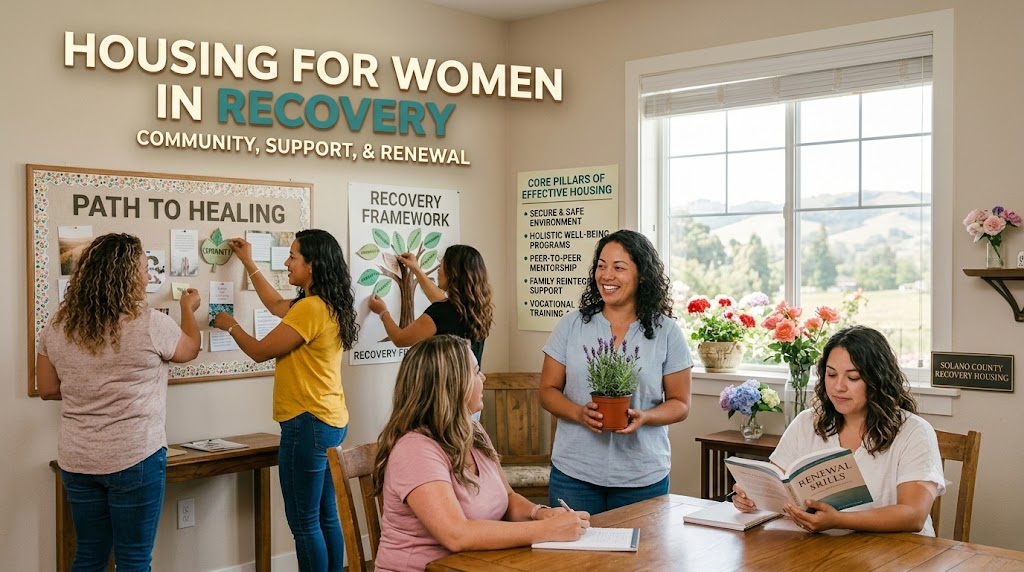
What Effective Housing for Women in Recovery Needs to Get Right
Given everything above, here is what genuinely effective housing for women in recovery in Solano County needs to provide. These are not nice-to-haves. They are the difference between a program that produces real change and one that simply provides temporary accommodation.
1. A Trauma-Informed Environment
Every policy, every staff interaction, and every aspect of daily life in the program needs to be shaped by an understanding of trauma. This means staff who respond to difficult behavior with curiosity rather than punishment. It means house rules that are firm but never humiliating. It means recognizing that a woman who seems resistant or withdrawn may simply be protecting herself in the only ways she has ever known how.
Trauma-informed care does not mean having no expectations. It means holding expectations in a way that communicates safety rather than threat.
2. A Women-Only Setting
This matters more than it might initially seem. A women-only residential environment does several things simultaneously. It removes a significant source of potential safety concern. It creates the conditions for a specific kind of peer support and honesty that is harder to access in mixed-gender settings. And it signals to residents that this space was built with them specifically in mind, not as an afterthought.
At Hazel’s Tranquility Place, our women’s house in Cordelia, Fairfield is a dedicated women-only facility. Every aspect of the program is designed around the specific needs and experiences of women in recovery.
3. Staff Who Understand Gender-Responsive Practice
Gender-responsive practice means that the program actively accounts for the ways that gender shapes a woman’s experiences, needs, and strengths. Staff in a gender-responsive program understand the dynamics of domestic violence and coercive control. They know how to discuss trauma without retraumatizing. They recognize the particular pressures that women face around shame, appearance, relationships, and self-worth and they engage with those pressures directly and compassionately.
4. Structure That Feels Supportive, Not Controlling
For women who have experienced controlling relationships or institutional environments, a new housing program with rules and schedules can initially feel threatening rather than supportive. The way structure is introduced and maintained matters enormously.
At Hazel’s Tranquility Place, structure is built around the resident’s wellbeing and explained in terms of its purpose. The daily routine exists to reduce anxiety, build healthy habits, and create a stable foundation. House rules exist to keep every resident safe and to create a community where trust can grow. When residents understand the why behind the structure, it shifts from feeling controlling to feeling supportive.
5. Real Life Skills That Address Women’s Specific Barriers
Stability after a housing for women in recovery placement depends on a woman being equipped with the practical tools she needs for independent living. For many women in recovery, those tools include financial literacy and independence, particularly for women who have not had control of their own finances. They include understanding and accessing benefits and legal protections. Also, they include communication skills for rebuilding relationships with children and family members. They include employment readiness that accounts for gaps in work history.
At Hazel’s Tranquility Place, life skills programming is built into daily residential life and designed around the real barriers that women in our program face.
6. Connection to Community Resources
No housing program can provide everything a woman in recovery needs. The programs that produce the best outcomes are the ones that connect residents to the full range of community resources available to them, including behavioral health services, legal aid, employment support, benefits enrollment, and peer recovery networks.
Hazel’s Tranquility Place coordinates actively with our sister organization Solano Impact Care to ensure that residents have access to comprehensive care management, community resource navigation, and trauma-informed support beyond the walls of the residential program.
Call Now: 707-301-4051
What to Expect From the Women’s House at Hazel’s Tranquility Place
If you are a family member considering housing for women in recovery in Solano County at Hazel’s Tranquility Place, here is a clear, honest picture of what she will experience.
A safe, home-like environment
The women’s house in Cordelia, Fairfield is clean, comfortable, and designed to feel like a real home. Physical environment matters in recovery and stabilization. Residents live in a space that communicates care and respect from the moment they walk in.
A structured daily routine
Every day includes set mealtimes, programming, personal development time, and a clear schedule. For women who have been living in chaos, this predictability is itself therapeutic. The routine is not rigid for its own sake. It is intentionally designed to reduce anxiety, build healthy habits, and prepare residents for the demands of independent living.
Medication management support
For residents managing psychiatric conditions, chronic health needs, or Medication-Assisted Treatment, our staff provide hands-on medication management support. Consistent medication adherence during the recovery period is one of the strongest predictors of long-term stability.
Life skills programming
Practical programming covers budgeting, cooking, communication, employment readiness, and independent living preparation. These are not one-off workshops. They are built into daily residential life because real skill development requires repetition and practice over time.
Peer community
Living alongside other women who are navigating similar recovery journeys creates a source of support and accountability that professional staff alone cannot replicate. The peer community at Hazel’s Tranquility Place is one of the most consistent things that residents describe as meaningful during their placement.
Active care coordination
Our team coordinates with each resident’s existing providers including therapists, psychiatrists, case managers, and primary care physicians throughout the placement. Residents do not experience a gap in care when they enter our program. They experience continuity.
Individualized transition planning
Every resident has a clear path forward. From day one, staff work with each woman to develop a realistic, individualized plan that addresses housing, employment, health, benefits, and relationships. The goal is always movement toward genuine independence, not just completion of a placement.
Signs That a Woman You Love May Need This Level of Support
Sometimes families know that something needs to change but are not sure whether housing for women in recovery is the right answer. Here are the signs that it likely is.
The woman you are concerned about may benefit from a structured recovery housing program if:
- She is leaving a hospital, psychiatric facility, or treatment program with no safe, stable housing to return to
- She has a history of cycling through crisis services, emergency rooms, or unstable living situations without achieving lasting stability
- She is in early recovery and cannot safely return to the environment associated with her substance use
- She is managing serious mental illness or a co-occurring condition that requires daily professional support
- Her current home environment is unsafe due to domestic violence, substance use by others in the home, or a lack of appropriate support
- She has practical life skills gaps that make independent living currently unrealistic without support
- Family members are willing to help but are not equipped to provide the level of structured daily support she genuinely needs right now
If several of these apply, housing for women in recovery in Solano County is not a last resort. It is a clinically and practically sound decision that gives this transition the best possible foundation.
Call Now: 707-301-4051
For Families — What You Should Know Before You Call
Reaching out about housing for a woman you love takes courage. You may have been managing this situation for a long time. or may feel guilty about considering a residential placement. You may worry about how she will respond.
Here is what we want you to know.
Choosing housing for women in recovery for someone you care about is not giving up on her. It is recognizing that she deserves professional support during one of the hardest periods of her life, support that goes beyond what love alone can provide. That is not a failure of love. It is an expression of it.
When you contact Hazel’s Tranquility Place, here is what to expect:
- An honest conversation about whether our program is the right fit, not a sales pitch
- Clear information about what our women’s house provides and what it does not
- A respectful, unhurried intake process that takes the full picture into account
- Guidance on next steps whether or not our program turns out to be the right option
- Ongoing communication throughout the placement with your loved one’s consent
You can reach us by calling 707-301-4051, emailing info@hazelstranquility.org, or visiting hazelstranquility.org to submit a referral. You can also read up on how to submit housing referral.
Call Now: 707-301-4051
Frequently Asked Questions
Does the women’s house at Hazel’s Tranquility Place accept women with children?
Our women’s house in Cordelia, Fairfield currently serves women only, so if you are seeking housing for a woman with children please contact us directly so we can discuss the situation and help identify the most appropriate options available.
Can a woman refer herself or does the referral need to come from a professional?
Women can absolutely contact Hazel’s Tranquility Place directly and we welcome self-referrals because a woman reaching out for herself is demonstrating exactly the kind of initiative that our program is designed to support.
What happens if a woman is not ready for structured housing yet?
Readiness looks different for everyone and our team will have an honest conversation about where someone is and what level of support makes the most sense right now rather than pushing a placement that is not the right fit.
How does the women’s house handle situations involving domestic violence history?
Our staff are trained in trauma-informed, gender-responsive practice and approach every resident’s history with care and confidentiality, understanding that domestic violence survivors need safety, consistency, and trust above all else.
How quickly can a placement be arranged for a woman approaching discharge or release?
Bed availability changes quickly so the earlier you contact us the better, and our team works to respond to all referral inquiries within one business day to minimize the gap between discharge and placement.
Safe Housing for Women in Recovery, Built Right Here in Solano County
Housing for women in recovery in Solano County exists because K Patrice Williams saw a need and refused to walk past it. She built Hazel’s Tranquility Place for the women in Solano County who were falling through the gap between crisis and stability, and she named it after her own mother because she understood that behind every woman in recovery is a story worth honoring.
If someone you love is at a turning point right now, do not wait for the next crisis to act. Reach out to Hazel’s Tranquility Place today. Our team is ready to answer your questions, check availability at our Cordelia, Fairfield women’s house, and help you find the right next step for the woman you care about.
Call Now: 707-301-4051. Also, you can visit hazelstranquility.org or email info@hazelstranquility.org to submit a referral or learn more about our program.