
When families and professionals first explore supportive housing for a vulnerable adult, most of the conversation centers on the immediate need. Finding a safe place. Securing a placement. Getting through the crisis. Those things matter enormously and they deserve the attention they get.
But there is a question that does not get asked often enough at the beginning of the process. What comes after?
At Hazel’s Tranquility Place, independence after supportive housing in Solano County is not an afterthought. It is the point. Every service we provide, every routine we build, every plan we develop with a resident is oriented toward a single goal. Helping that person move forward with the skills, resources, and support network they need to live a stable, self-directed life beyond our program.
This article maps out what independence actually looks like for adults leaving supportive housing in Solano County, what it takes to get there, and how Hazel’s Tranquility Place builds toward it from the very first day of a resident’s placement.
Call Now: 707-301-4051
What Independence After Supportive Housing Actually Means
Independence after supportive housing does not mean doing everything alone with no support whatsoever. That is not what independence means for anyone. Most adults with stable lives rely on systems, relationships, and community resources that support their daily functioning. The difference is that they access those supports by choice and from a position of stability rather than desperation.
For adults leaving supportive housing in Solano County, independence looks like:
- Living in a stable, safe housing situation without requiring daily residential oversight
- Managing medications consistently without hands-on daily support from program staff
- Meeting financial obligations through benefits, employment, or a combination of both
- Attending outpatient appointments and engaging with community-based care on their own initiative
- Navigating daily challenges without those challenges escalating into crises that require emergency intervention
- Maintaining healthy relationships with family, peers, and community members
- Having a clear sense of goals and the practical capacity to work toward them
None of this happens overnight. And none of it happens without intentional preparation during the supportive housing placement itself. That preparation is what distinguishes a program that produces genuine independence after supportive housing from one that simply provides temporary accommodation.
Why the Path to Independence Starts on Day One
One of the most common misconceptions about supportive housing is that transition planning happens at the end of a placement. In reality, at Hazel’s Tranquility Place, it begins the moment a resident walks through the door.
This matters because the skills, habits, and connections that make independence possible are not built overnight. They develop gradually through consistent practice over time. A resident who spends their entire placement focused only on immediate stabilization and begins thinking about what comes next in the final weeks is not nearly as prepared as one who has been actively working toward independence throughout.
Here is how that early investment in independence plays out across the dimensions of a resident’s placement:
Routine building from the start
The structured daily schedule at Hazel’s Tranquility Place is not just about maintaining order in the home. It is about building the daily habits that independent living requires. Consistent wake times, mealtimes, and activity schedules during the placement create the internal rhythm that residents carry with them after they leave.
Skill development that compounds
Life skills programming at Hazel’s Tranquility Place covers budgeting, cooking, communication, appointment management, and employment readiness. These are not one-time workshops. They are ongoing components of daily residential life. Skills practiced repeatedly during a placement become genuine capabilities rather than theoretical knowledge.
Goal setting that gives direction
Every resident at Hazel’s Tranquility Place develops an individualized life and stability plan at intake that identifies their specific goals for housing, employment, health, relationships, and community connection. Those goals provide direction and motivation throughout the placement and serve as the roadmap for transition planning as the resident approaches independence.
Call Now: 707-301-4051
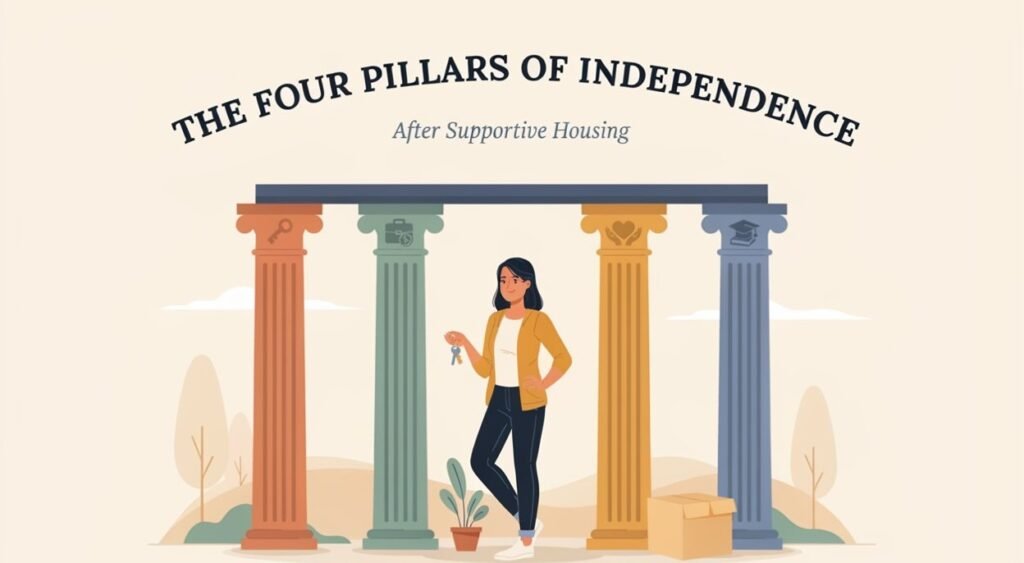
The Four Pillars of Independence After Supportive Housing
Based on what the evidence shows and what we see in practice at Hazel’s Tranquility Place, independence after supportive housing in Solano County rests on four interconnected pillars. All four need to be in place before a transition to independent living is genuinely ready to happen.
1. Stable Housing
The first and most immediate dimension of independence is a confirmed, appropriate next housing placement. This means a permanent or longer-term housing option that matches the resident’s income, support needs, and community connections.
At Hazel’s Tranquility Place, we actively support residents in identifying and applying for permanent housing options throughout their placement. This includes permanent supportive housing programs, subsidized housing, and market-rate rentals depending on each resident’s specific circumstances and readiness. We also connect residents to housing navigation resources in Solano County that can assist with applications, documentation, and move-in logistics.
2. Financial Stability
A resident cannot maintain independent housing without reliable income. Financial stability for adults leaving supportive housing in Solano County may come from several sources including benefits enrollment, part-time or full-time employment, or a combination of both.
During a placement at Hazel’s Tranquility Place, we support residents in enrolling in all benefits they qualify for including Medi-Cal, CalFresh, and SSI/SSDI where applicable. For residents working toward employment, our life skills programming includes financial literacy, budgeting, and employment readiness that builds toward earned income over time. Our coordination with Solano Impact Care extends this support further through community resource navigation that connects residents to employment programs and financial counseling services across Solano County.
3. Health and Behavioral Health Management
Independence after supportive housing requires that a resident can manage their health and behavioral health needs without daily residential oversight. This means consistent medication adherence, active engagement with outpatient treatment, and the self-awareness to recognize early warning signs and seek help before a crisis develops.
At Hazel’s Tranquility Place, medication management support during the placement builds the habits and systems that residents carry into independent living. More importantly, we ensure that every resident transitions with confirmed connections to outpatient providers so that clinical support does not disappear the moment they leave our program.
4. Community Connection
Social isolation is one of the strongest predictors of relapse and crisis recurrence among adults leaving supportive housing. Genuine independence requires community. Relationships with peers who support rather than undermine recovery. Connection to community organizations and resources. A sense of belonging to something larger than a residential program.
Throughout a placement at Hazel’s Tranquility Place, we actively support community integration by connecting residents to recovery support networks, community organizations, faith communities, and employment environments across Solano County. The peer community built inside the home is itself a foundation for the broader social network residents need after transition.
What the Transition Process Actually Looks Like
Understanding what the transition from supportive housing to independence looks like in practice helps families and professionals know what to expect as a resident approaches the end of their placement.
At Hazel’s Tranquility Place, here is how the transition process unfolds:
Ongoing assessment throughout the placement
Rather than a single evaluation at the end of a placement, our staff continuously assess each resident’s readiness across all four pillars of independence. This ongoing assessment means that readiness for transition is recognized when it actually exists rather than assumed based on a fixed timeline.
Transition planning conversations
As a resident demonstrates readiness across multiple dimensions, formal transition planning conversations become the focus of regular check-ins with staff. These conversations cover confirmed housing, income and benefits status, clinical support continuity, and community connections. Every item needs a clear answer before transition is scheduled.
A supported move, not a sudden discharge
Leaving a supportive housing program is itself a vulnerable transition. At Hazel’s Tranquility Place, we plan the move with intention. We confirm the next housing placement, coordinate with the resident’s ongoing care team, and provide support through the move itself rather than simply providing a discharge date and wishing someone well.
Post-transition connection
Independence after supportive housing does not mean cutting all ties with the program. We maintain connection with residents after transition where possible and welcome residents to reach out if they encounter challenges. Our relationship with Solano Impact Care extends this post-transition support through ongoing care management and community resource navigation that continues beyond the residential placement itself.
For families supporting a loved one through this process, our guide on what families can expect when referring a loved one to Hazel’s Tranquility Place] covers what involvement looks like throughout the placement and into the transition period.
Call Now: 707-301-4051
How Families Can Support the Journey Toward Independence
For family members, watching a loved one move toward independence after supportive housing is one of the most meaningful experiences the entire journey offers. It is also one that requires some intentionality to navigate well.
Here is how families can best support a loved one’s path to independence during and after a supportive housing placement:
- Trust the process and resist the urge to fast-track the transition before all four pillars are genuinely in place
- Stay involved in care planning conversations where appropriate and with your loved one’s consent
- Celebrate incremental progress rather than waiting for full independence to acknowledge growth
- Prepare your own home environment and relationship dynamics if your loved one plans to reconnect more closely with family after transition
- Reach out to our team if you have concerns about transition readiness before a discharge date is finalized
For professionals supporting a resident through this transition, our article on what is a housing stabilization plan and how does it work explains exactly how individualized planning maps the path from placement to independence.
Independence Is the Goal
Independence after supportive housing in Solano County does not happen because someone wanted it badly enough. It happens because the right preparation was in place during the right window. Because skills were built, connections were made, resources were secured, and a clear plan was followed through.
At Hazel’s Tranquility Place, that preparation is what we do. Every structured routine, every life skills session, every care coordination call, every transition planning conversation is a step toward the day a resident walks out of our program into a life they can sustain on their own terms.
If you are a family member, professional, or individual looking for a supportive housing program in Solano County that takes the long view, we would love to talk.
Call Now: 707-301-4051
Visit hazelstranquility.org or email info@hazelstranquility.org to learn more or submit a referral today.