
The moment a doctor says someone is medically cleared for discharge, the focus shifts. The clinical team has done what medicine can do. The acute crisis has been managed. And now the question that determines everything that comes next is this: where does this person go?
For many patients, that question has a simple answer. They go home to a stable, supported environment where recovery can continue safely. But for a significant and growing number of adults across Solano County, the answer is not simple at all. They go back to housing instability. They return to environments full of the same triggers, stressors, and absence of support that contributed to their hospitalization in the first place. Or worse, they leave the hospital with nowhere to go at all.
And then they come back. Sometimes within days.
Housing after hospital discharge is not a peripheral concern that sits outside the boundaries of clinical care. It is one of the most powerful variables in whether the work done during a hospitalization actually holds. Where someone lives after discharge shapes their medication adherence, their ability to attend follow-up appointments, their mental health stability, and ultimately whether they end up back in the emergency room within 30 days or begin a genuine trajectory toward recovery. This article explains why housing matters so much after hospital discharge and what the right housing support actually looks like in practice.
Call Now: 707-301-4051
What Actually Happens When Discharge Housing Goes Wrong
Before making the case for what good post-discharge housing looks like, it helps to be honest about what happens when it goes wrong. Because it goes wrong constantly and the consequences are serious for patients, families, and the healthcare system alike.
Here is what the research consistently shows:
Adults discharged to unstable housing situations are significantly more likely to be readmitted within 30 days than those discharged to structured, supported environments. According to research published in Health Affairs, housing instability is one of the strongest independent predictors of hospital readmission across psychiatric, medical, and substance use discharge categories.
Beyond readmission rates, poor discharge housing produces cascading consequences:
- Medication non-adherence develops quickly when there is no structured support maintaining consistency. Psychiatric stability achieved during hospitalization can unravel within days without medication management support in the home environment
- Follow-up appointments get missed at dramatically higher rates when patients return to chaotic, unsupported living situations. The clinical plan built during hospitalization falls apart without the outpatient engagement it depends on
- Mental health deteriorates faster in environments characterized by conflict, substance use, overcrowding, or chronic stress. The therapeutic gains of an inpatient stay erode rapidly when the living environment actively undermines them
- Substance use relapse spikes when individuals in early recovery return to environments associated with their addiction. Physical proximity to the people, places, and situations most connected to substance use during the highest-risk window is one of the most reliable predictors of immediate relapse
- Families absorb unsustainable levels of care responsibility when no appropriate residential support exists. That absorption often fails, creating the conditions for a crisis that sends the patient back to the emergency room
Every one of these outcomes is preventable. Not always. But far more often than current discharge planning practice achieves. And the intervention that prevents them most reliably is appropriate, structured housing support in the period immediately following discharge.
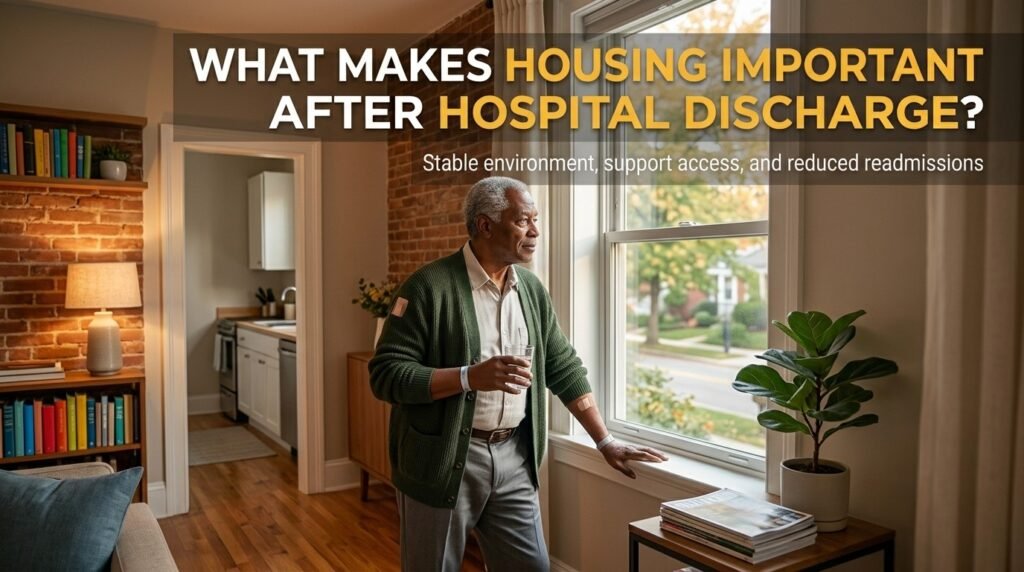
What Makes Housing Important After Hospital Discharge
Understanding why housing matters after hospital discharge requires going beyond the general claim that stable housing is good for health. The specific mechanisms through which housing affects post-discharge outcomes are important to understand because they point directly to what the housing environment needs to provide.
Medication management is environment-dependent
During hospitalization, nursing staff manage medications precisely and consistently. The moment a patient is discharged, that management falls to the patient and whatever support exists in their home environment. For patients managing complex psychiatric regimens, Medication-Assisted Treatment, or multiple chronic conditions, the gap between inpatient medication management and independent management at home is enormous.
A structured residential environment that provides hands-on medication management support closes that gap. At Hazel’s Tranquility Place, staff monitor that residents are taking medications and following care plans daily. This is not incidental to our program. It is one of the most clinically significant things we do.
Follow-up appointment attendance requires infrastructure
Getting to follow-up appointments after discharge requires transportation, motivation, scheduling capacity, and the basic daily functioning that housing instability actively undermines. Structured residential programs that actively support appointment attendance, through transportation assistance, reminders, and the daily structure that makes appointments manageable, dramatically improve follow-up rates compared to unsupported home environments.
At Hazel’s Tranquility Place, Partnership HealthPlan covers transportation to medical appointments for our residents. Our women’s program in Cordelia, Fairfield offers Fairfield Fast Connect door-to-door pickup for non-medical trips. Our men’s program in Glen Cove, Vallejo has SolTrans bus access nearby. Transportation barriers, one of the most common reasons follow-up appointments are missed, are actively addressed rather than left to the patient to navigate independently.
Clinical coordination requires a stable base
The care coordination work that happens after discharge, connecting patients to primary care, behavioral health services, specialist follow-up, and community resources, requires a stable residential base to work from. A patient who is couch-surfing, moving between temporary arrangements, or living in an environment that changes week to week cannot reliably maintain the clinical connections that post-discharge recovery requires.
At Hazel’s Tranquility Place, our sister organization Solano Impact Care provides Enhanced Care Management that helps residents enroll with a primary care physician, connects them to healthcare providers, and coordinates all medical needs. This service is typically authorized for up to 12 months through Partnership HealthPlan or Kaiser and is available regardless of bed placement. That coordination infrastructure is what post-discharge recovery actually needs to function.
Environmental stress directly undermines recovery
The stress of an unstable housing situation is not a background condition that patients manage alongside their recovery. It is an active, physiological obstacle to recovery. Chronic stress elevates cortisol, disrupts sleep, impairs emotional regulation, and reduces the brain’s capacity for the clear thinking and healthy decision-making that recovery requires.
A safe, calm, structured residential environment removes that chronic stress and replaces it with the predictability and security that healing needs. This is not soft language. It is the documented neurological reality of how environment affects the recovering brain.
Call Now: 707-301-4051

What Hazel’s Tranquility Place Provides After Hospital Discharge
Hazel’s Tranquility Place provides structured, supportive housing in Solano County for adults who need more than shelter during a vulnerable transition. Our program was founded in 2019 by Councilmember K. Patrice Williams and named in honor of her mother, Hazel. Our mission is to meet clients where they are by providing compassionate, dignified care and support, treating every individual with the same respect and care we would extend to our own family.
For adults being discharged from hospitals across Solano County, here is specifically what our program provides:
Safe, structured residential facilities
We operate two facilities currently, a women’s program in Cordelia, Fairfield and a men’s program in Glen Cove, Vallejo, with a third facility opening in Spring 2026. Both existing facilities are clean and sober living environments with spacious bedrooms, no bunk beds, no garage or living room placements, and most rooms configured with two beds. A few larger master rooms accommodate three residents. Our women’s house is entirely ground level with no stairs. Our men’s house has the majority of rooms upstairs with one downstairs bedroom and a staircase with a mid-way landing. Both facilities have walk-in showers with handrails and grab bars next to toilets.
Daily on-site staff and medical support
Both facilities have daily on-site staff. Our women’s house has a live-in medical assistant providing continuous support. Staff monitor that residents are eating, taking medications, and following their care plans every day. External providers including physical therapists and wound care nurses are welcome to visit residents on-site. Our bilingual staff, including the medical assistant and a care coordinator who speak Spanish, ensure that language is not a barrier to care.
Enhanced Care Management through Solano Impact Care
Every resident at Hazel’s Tranquility Place has access to Enhanced Care Management through Solano Impact Care. A dedicated care manager helps enroll residents with a primary care physician, connects them to healthcare providers, and coordinates all medical needs. This is exactly the kind of clinical coordination infrastructure that post-discharge recovery requires and that standard home environments cannot provide.
Housing Navigation and Sustainability
Our housing navigation support works with each resident individually to identify income, realistic housing options, roommate situations, waitlists, and applications. Our post-placement housing sustainability program helps residents keep their housing after they transition out, covering budgeting, tenant rights, landlord mediation, and general life skills. The community support navigator on our team has personal experience navigating the local housing system, which means residents are getting guidance from someone who genuinely understands the challenges they face.
Amenities that support daily functioning
Full kitchen and refrigerator access, high-speed Wi-Fi, beautiful gardens and outdoor spaces, a communal TV lounge, a shared computer for resident use, and access to grocery store and thrift store trips all contribute to the quality of daily life that recovery requires. These are not luxuries. They are the practical foundations of a functioning daily life.
For a complete picture of our facilities, staffing, admission requirements, and services, download our fact sheet at hazelstranquility.org/fact-sheet.
Who Hazel’s Tranquility Place Serves After Discharge
Our program focuses on specific populations that hospital discharge planners and social workers encounter regularly. Understanding who we serve helps you identify quickly whether a patient you are working with is a strong candidate for placement with us.
Our populations of focus include:
- High hospital utilizers who cycle through emergency departments and inpatient units without a stable post-discharge destination
- Justice-involved individuals who are also navigating behavioral health or medical needs alongside their reentry process
- Adults experiencing homelessness or at risk of homelessness following discharge
- Adults with behavioral health and medical needs that require more than a standard home environment can support
- Adults requiring SUD services as part of their post-discharge recovery plan
Our admission requirements are specific and important to understand before making a referral. Residents must be alert, oriented, and able to engage with an intake specialist. Medications must be self-administered. Residents must be independent with hygiene unless arriving with a formally assigned IHSS support person. Oxygen patients must independently manage a personal portable unit. Residents must be established with appropriate aftercare services including wound care, physical therapy, home health, or IHSS where applicable. Both facilities are clean and sober living environments.
If a patient requires detox or stabilization before placement, we will recommend a higher level of care prior to admission rather than accepting a placement that will not serve them well.
How to Refer a Patient to Hazel’s Tranquility Place After Discharge
The referral process at Hazel’s Tranquility Place is straightforward and designed to work within the realities of hospital discharge timelines.
Step 1: Submit the referral
Submit your referral through one of three channels. Online at hazelstranquility.org or solanoimpactcare.org, which is the preferred method. By email at care@solanoimpactcare.org. By phone at 707-301-4051. Our standard turnaround for referrals is 48 hours. Call directly for expedited placement when timing is urgent.
Step 2: Include all relevant patient information
Indicate all patient barriers in the referral so we can identify needs or determine whether the patient might benefit from other services even if they are not appropriate for bed placement. Complete information produces faster, better decisions.
Step 3: We review and evaluate
Every referral is evaluated for all available services, not just bed placement. A patient who does not qualify for residential placement may still qualify for Enhanced Care Management, housing navigation, or other support services through Solano Impact Care.
Step 4: Assessment
We conduct an assessment covering mobility, activities of daily living, health and wellness, and independence to confirm fit and prepare for a smooth admission.
Step 5: Intake and coordination
Solano Impact Care receives the referral, verifies eligibility, schedules an intake coordinator meeting, and provides approval or alternative referral recommendations.
We actively partner with SNF units, ED navigators, SUD services, CBOs and nonprofits, and post-acute discharge managers across Solano County. If your organization wants to establish a formal referral partnership, reach out through hazelstranquility.org or email care@solanoimpactcare.org to request a presentation.
Call Now: 707-301-4051
What Families Should Know About Post-Discharge Housing
If you are a family member whose loved one is approaching hospital discharge and you are worried about what comes next, here is what we want you to know.
Your concern is justified. The post-discharge period is genuinely high-risk and the environment your loved one returns to matters enormously. But you do not have to figure this out alone and you do not have to choose between bringing your loved one home to an environment that cannot support their recovery and leaving them without options.
Hazel’s Tranquility Place is a real alternative. A safe, structured, professionally staffed residential environment where your loved one can continue recovering from hospitalization with the daily support that recovery actually requires.
You can contact us directly at 707-301-4051 or through hazelstranquility.org. You do not need to go through a professional referral source to start the conversation. Our team will talk through your loved one’s situation honestly and help you understand whether our program is the right fit.
Call Now: 707-301-4051
Frequently Asked Questions
How quickly can a patient be admitted to Hazel’s Tranquility Place after hospital discharge?
Our standard referral turnaround is 48 hours and we offer expedited placement for urgent discharge situations, so calling us directly at 707-301-4051 as early in the discharge planning process as possible gives us the most time to assess fit and coordinate a smooth transition.
Does Hazel’s Tranquility Place accept patients who are on Medi-Cal?
Yes, we are credentialed by Partnership HealthPlan, Medi-Cal, and Kaiser Permanente, and our Enhanced Care Management services through Solano Impact Care are typically authorized for up to 12 months through Partnership HealthPlan or Kaiser.
What if a patient needs medication administration support rather than self-administration?
Our admission requirements currently specify that residents must be independent with medications through self-administration, so patients requiring administered medications may need a higher level of care and our team will help identify the most appropriate alternative option.
Can external providers continue visiting a patient after they are admitted to Hazel’s Tranquility Place?
Yes, external providers including physical therapists, wound care nurses, and other healthcare professionals are welcome to visit residents on-site at both our Vallejo and Fairfield facilities.
What happens if a patient does not qualify for bed placement but still needs support?
Every referral we receive is evaluated for all available services through Solano Impact Care, not just bed placement, which means patients who do not meet our residential admission criteria may still qualify for Enhanced Care Management, housing navigation, or other community-based support services.
Housing After Discharge Is Not Optional
The question of where someone goes after hospital discharge is not an afterthought or a logistics problem. It is a clinical decision with direct consequences for everything the hospitalization was trying to achieve.
At Hazel’s Tranquility Place, we receive adults directly from hospital discharge and provide the safe, structured, compassionately staffed environment that post-discharge recovery genuinely requires. Our facilities, our staffing model, our clinical coordination through Solano Impact Care, and our commitment to treating every resident with the dignity we would extend to our own family all exist in service of one goal. Making sure that what happens after discharge supports rather than undermines the recovery that began inside the hospital.
If you have a patient approaching discharge right now, do not wait to start the conversation.
Call Now: 707-301-4051
Visit hazelstranquility.org or email care@solanoimpactcare.org to submit a referral or learn more about our program and current availability.