
Getting someone placed in a supportive housing program feels like crossing the finish line. The referral is made. The intake is complete. The person you have been trying to help is finally somewhere safe and structured. For families, that moment brings real relief. For professionals, it represents a task completed in a caseload that never stops growing.
But here is the thing. Placement is not the finish line. It is the starting line.
What happens in the days, weeks, and months after someone enters a supportive housing program determines whether that placement produces genuine, lasting stability or simply becomes another entry in a long list of interventions that did not quite stick. And one of the most important factors in which direction things go is something surprisingly simple. Follow-up.
Follow-up after placement in supportive housing is not a formality. It is an active, ongoing process that keeps the care team aligned, catches problems before they escalate, supports the resident through the inevitable challenges of stabilization, and ultimately determines whether the work everyone invested in the placement actually pays off.
At Hazel’s Tranquility Place, we take follow-up seriously from both sides of the equation. Our team follows up with residents, with families, and with referring professionals throughout every placement. And we actively encourage the same from everyone involved in a resident’s care. This article explains why follow-up matters so much, what it looks like in practice, and what happens when it does not happen.
Call Now: 707-301-4051
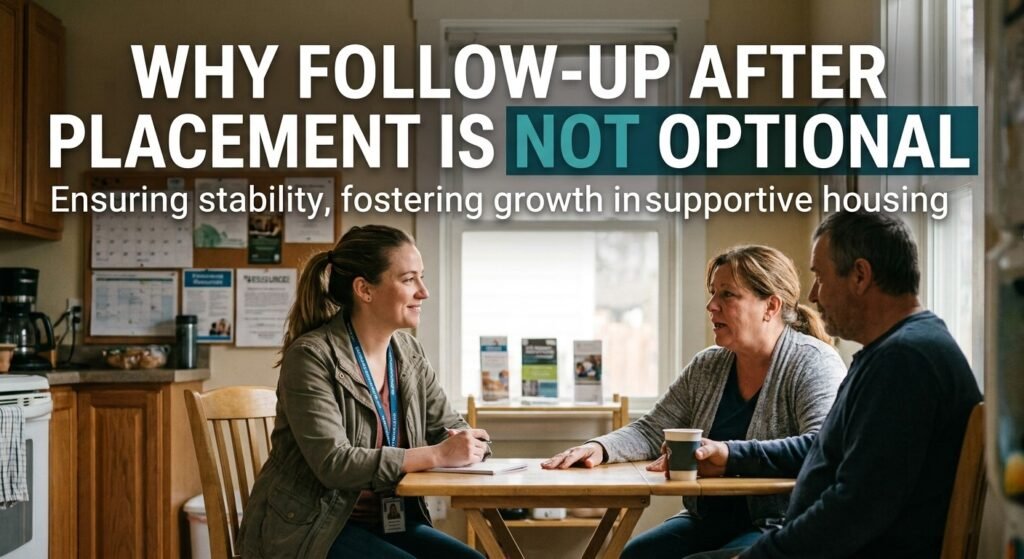
Why Follow-Up After Placement Is Not Optional
The period immediately after placement is one of the most vulnerable points in the entire supportive housing journey. A new resident is adjusting to an unfamiliar environment, navigating new house expectations, meeting new peers, and managing the emotional weight of a major life transition, all at the same time.
Even in the best programs with the most experienced staff, the early weeks of a placement surface challenges that the intake process could not fully anticipate. Medication adjustments that need clinical input. Family dynamics that create tension. Behavioral patterns that emerge once the initial structure settles in. Practical gaps in benefits or documentation that affect the resident’s stability.
Without active follow-up from the broader care team, these challenges go unaddressed until they become crises. With active follow-up, they get caught early and addressed before they derail the placement.
Here is specifically what follow-up after placement does that nothing else can replicate:
- It creates a feedback loop between the housing program, the clinical team, and the referring professional so that everyone is working from the same current picture of how the resident is doing
- It signals to the resident that the people who helped them get placed have not forgotten about them, which itself has a measurable effect on engagement and motivation
- It gives families a channel for sharing observations that the housing program may not be able to see directly
- It allows the care plan to be adjusted in real time as the resident’s needs evolve rather than waiting for a scheduled review that may come too late
- It catches early warning signs of deterioration before they require emergency intervention
Research from the National Institute of Mental Health consistently shows that coordinated, ongoing follow-up after residential placement significantly reduces psychiatric readmission rates, improves medication adherence, and increases long-term housing retention. Follow-up is not supplementary to good supportive housing practice. It is integral to it.
What Follow-Up Looks Like for Professionals
For case managers, discharge planners, probation officers, and behavioral health providers, follow-up after placement is one of the most impactful things you can do for a client without adding significantly to your workload. Here is what effective professional follow-up actually looks like.
Stay in contact with the housing program
At Hazel’s Tranquility Place, referring professionals have a named contact throughout every placement. Use that contact. Check in periodically rather than waiting for a crisis to prompt the conversation. A brief check-in call or email every few weeks keeps you informed, keeps us informed about your priorities for this client, and ensures that nothing significant falls through the cracks between systems.
Attend care conferences
When Hazel’s Tranquility Place convenes a care conference for a complex resident, attend it. Care conferences bring together every professional involved in a resident’s plan and align the team around current goals, challenges, and next steps. Your presence and your perspective matter. A case manager who shows up to a care conference sends a message to the resident that their team is invested and coordinated.
Share new information promptly
If something changes in your client’s broader situation, a court date, a benefits decision, a family development, a clinical update, share it with the housing program as soon as you know. Information that feels tangential from your perspective can be critically important to the staff who are with your client every day.
Do not close the case prematurely
One of the most common professional follow-up failures is closing or deprioritizing a case the moment a placement is confirmed. The placement is the beginning, not the resolution. Keep the case active, maintain your involvement, and treat the placement period as an ongoing phase of your client’s care rather than a concluded chapter.
Our article on common referral mistakes to avoid in supportive housing covers this pattern in more detail alongside other follow-up related errors that professionals frequently make.
Call Now: 707-301-4051
What Follow-Up Looks Like for Families
For families, follow-up after placement looks different from professional follow-up but it matters just as much. Here is how families can stay meaningfully involved without overstepping the boundaries that supportive housing programs maintain for good reasons.
Stay connected with your loved one
Regular, warm, low-pressure contact with your loved one during their placement matters. You do not need to visit every day or call multiple times a week. But consistent contact, a call on Sunday evenings, a visit twice a month, a text checking in, signals that you are present and invested without creating the kind of pressure that can destabilize someone in the early weeks of a placement.
Share relevant observations with the housing program
You see your loved one with different eyes than the staff do. If something concerns you during a visit or a call, share it with the housing program team rather than sitting on it or only discussing it with your loved one. You are not betraying your loved one by sharing a concern. You are being part of the care team.
Follow up on your own understanding of the plan
Ask questions. Stay informed about what the current goals are, what the transition plan looks like, and what your role is in supporting that plan. Families who understand the plan can support it. Families who do not understand the plan sometimes accidentally undermine it.
Keep your own follow-up consistent
The families whose loved ones do best in supportive housing programs are the ones who show up consistently, not dramatically. A reliable, calm, predictable family presence is more stabilizing than intense involvement that ebbs and flows based on how worried the family is at any given moment.
Our article on how families can work with case managers to support a loved one in supportive housing covers the full picture of productive family involvement throughout a placement.

What Follow-Up Looks Like From Hazel’s Tranquility Place
Follow-up is not just something we encourage from families and professionals. It is something we practice ourselves across every placement at Hazel’s Tranquility Place.
Here is what our follow-up commitment looks like in practice:
Proactive updates to referring professionals
We do not wait for referral partners to ask how a resident is doing. We share proactive updates on participation, progress, and any significant changes in condition. Referring professionals should never have to wonder whether their client is okay after a placement with us.
Prompt incident communication
When something significant happens inside the program, a behavioral incident, a medication concern, a safety issue, a change in the resident’s condition, we notify the relevant contacts immediately. Not after the fact. Not in the next scheduled update. Right away.
Regular individual check-ins with residents
Our staff check in individually with every resident throughout the day. These are not clinical assessments. They are genuine human conversations that build the trust and relational safety that allow residents to share what is actually going on before it becomes a problem.
Coordination with Solano Impact Care
Our sister organization Solano Impact Care provides comprehensive care management that extends the follow-up network beyond our residential team. Their involvement means that follow-up does not depend entirely on our internal capacity. It is built into the broader coordination structure that surrounds every placement.
Transition follow-up
Follow-up does not stop when a resident transitions out of our program. We maintain connection with former residents and their care teams where possible and actively support the post-transition period as a continuation of the stabilization work rather than its conclusion. Our article on what does independence look like after supportive housing and how do residents get there covers what that post-transition support looks like in practice.
Call Now: 707-301-4051
What Happens When Follow-Up Does Not Happen
It is worth being direct about this because the consequences are real. When follow-up after placement breaks down, here is what tends to happen.
Small problems become big ones. A medication concern that would have been caught in a check-in call escalates into a psychiatric crisis because nobody noticed the early signs. A family dynamic that would have been navigated with support creates a conflict that destabilizes the resident because nobody knew it was building.
The care team loses alignment. The case manager is working from a picture of the client’s situation that is two months out of date. The housing program is not aware of a clinical development that affects how they should be supporting the resident. The family is making decisions based on what they hope is happening rather than what is actually happening.
The resident feels abandoned. One of the most destabilizing experiences for a vulnerable adult in early stabilization is the sense that the people who worked so hard to get them placed have now forgotten about them. That feeling does not stay quiet. It shows up in engagement, in trust, and in the resident’s belief that their recovery matters to anyone beyond themselves.
None of this is inevitable. All of it is preventable with consistent, intentional follow-up from every member of the care team.
Frequently Asked Questions
How often should a case manager follow up with the housing program after placing a client?
A brief check-in every two to three weeks is a reasonable baseline for most placements, with more frequent contact during the first month when adjustment challenges are most likely to surface and immediate contact any time a significant development occurs on either side.
What is the best way to initiate follow-up contact with Hazel’s Tranquility Place after a placement?
Call 707-301-4051 or email info@hazelstranquility.org and ask for your named contact, because every referring professional has a dedicated point of contact within our team so you never have to navigate a general inquiry line to check in on your client.
What if a family member tries to follow up but feels like they are not getting clear information?
Request a care conference through the housing program or through your loved one’s case manager, because a care conference brings the full team together and creates a structured forum for exactly the kind of information sharing that informal follow-up sometimes cannot fully achieve.
Does Hazel’s Tranquility Place follow up with residents after they transition out of the program?
Yes, we maintain connection with former residents and their care teams where possible because we understand that the transition out of supportive housing is itself a vulnerable period that benefits from continued follow-up rather than an abrupt ending of support.
Follow-Up Is How Placements Become Transformations
A placement without follow-up is a bed. A placement with consistent, intentional, coordinated follow-up is a turning point.
The difference between those two things is not the quality of the housing program or the dedication of any single professional. It is the commitment of everyone involved, the housing program, the case manager, the clinical team, and the family, to stay engaged after the placement is made and treat the entire stabilization period as a shared ongoing responsibility rather than a completed transaction.
At Hazel’s Tranquility Place, we hold up our end of that commitment across every placement at our three Solano County facilities. We ask our referral partners and the families we work with to hold up theirs. When everyone does, the outcomes we are all working toward actually materialize.
Reach out today if you have questions about how we handle follow-up or if you are ready to start a referral conversation.
Call Now: 707-301-4051
Visit hazelstranquility.org or email info@hazelstranquility.org to connect with our team.