
When someone you care about is navigating a major life transition, whether they are leaving a hospital, rebuilding after incarceration, or working through recovery, the question that keeps coming back is simple. What does this person actually need to succeed?
Not just survive. Actually succeed.
The answer, more often than not, comes down to three things. Safety. Accountability. Long-term stability. They are not marketing language. They are the three conditions that research, lived experience, and decades of work in supportive housing consistently point to as the foundation of lasting change.
At Hazel’s Tranquility Place, these three pillars shape everything. This article breaks down what each pillar actually means in practice, why it matters, and how safety accountability stability supportive housing works as a unified model rather than three separate ideas. Whether you are a family member trying to understand what good supportive housing looks like, or a professional evaluating programs for a client, this guide gives you the clearest possible picture.
Why These Three Pillars Matter More Than Most People Realize
Before getting into each pillar individually, it helps to understand why this particular combination is so powerful.
Many housing programs get one or two of these right. A shelter might provide physical safety but no real accountability structure. A sober living home might provide peer accountability but no clinical safety framework. A transitional program might offer short-term stability without the tools residents need to sustain it long term.
What makes effective supportive housing different is the presence of all three pillars working together simultaneously. When safety, accountability, and long-term stability are integrated into one consistent residential model, something genuinely different happens for residents. Progress compounds. Small wins build on each other. The person who arrived in crisis starts to look and feel like someone building a real life.
According to the Substance Abuse and Mental Health Services Administration (SAMHSA), stable housing combined with wraparound support services significantly reduces psychiatric hospitalizations, lowers substance use relapse rates, and improves long-term community integration outcomes. The National Alliance to End Homelessness similarly identifies structured, service-enriched housing as one of the most cost-effective interventions available for vulnerable adults.
These are not small claims. They reflect a large and consistent body of evidence that supportive housing done right changes trajectories in ways that emergency services, shelter beds, and good intentions alone simply cannot.
For families and professionals looking for a program that delivers on all three fronts, understanding what each pillar involves is the most important starting point.
Call Now: 707-301-4051
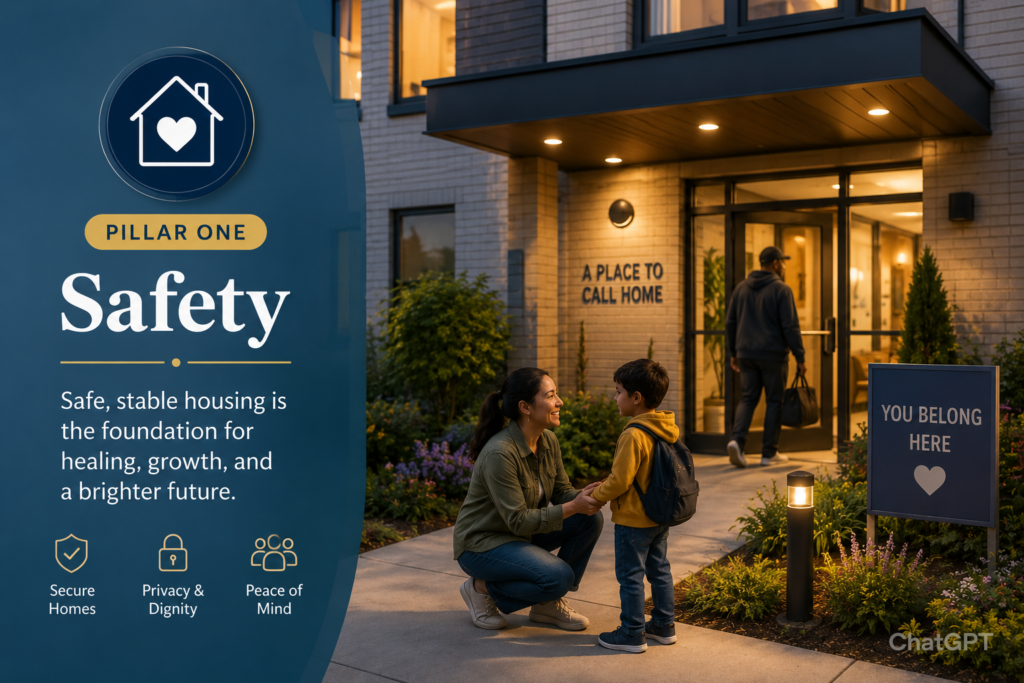
Pillar One — Safety
Safety is the foundation. Without it, nothing else is possible.
This sounds obvious. But genuine safety in a supportive housing context means much more than physical security. It means creating an environment where a person feels protected not just from external threats, but from the internal and social conditions that put their recovery and stability at risk.
At Hazel’s Tranquility Place, safety operates on three levels simultaneously.
Physical Safety
Our three facilities in Solano County, the men’s house in Glen Cove Vallejo, the women’s house in Cordelia Fairfield, and our Woodcreek Fairfield location, are clean, well-maintained, and professionally staffed. Residents live in home-like environments where basic physical safety is not a question. Lighting, space, cleanliness, and comfort all matter. A person cannot begin to heal in an environment that feels threatening or chaotic.
Emotional Safety
This is the piece that many housing programs underinvest in. Emotional safety means that residents feel respected, heard, and treated as full human beings rather than problems to be managed. It means that staff engage with genuine care. It means that the culture inside the home does not replicate the shame, judgment, or dehumanization that many residents have experienced in other systems.
Research from the National Institute of Mental Health consistently shows that perceived safety in a residential environment directly correlates with treatment engagement, medication adherence, and willingness to be vulnerable enough to do the real work of recovery. When people feel emotionally safe, they open up. When they open up, they heal.
Environmental Safety
For many vulnerable adults, the environments they return to after a crisis are themselves a source of risk. The presence of substances, unsafe relationships, triggering locations, and stressful living conditions all undermine recovery from the outside in. Structured housing creates physical and social distance from those environments during the period when that distance matters most.
Our article on Finding Safe and Supportive Housing in Solano County: A Guide to Stabilization covers what families and professionals should look for when evaluating whether a housing environment is genuinely safe for a vulnerable adult.
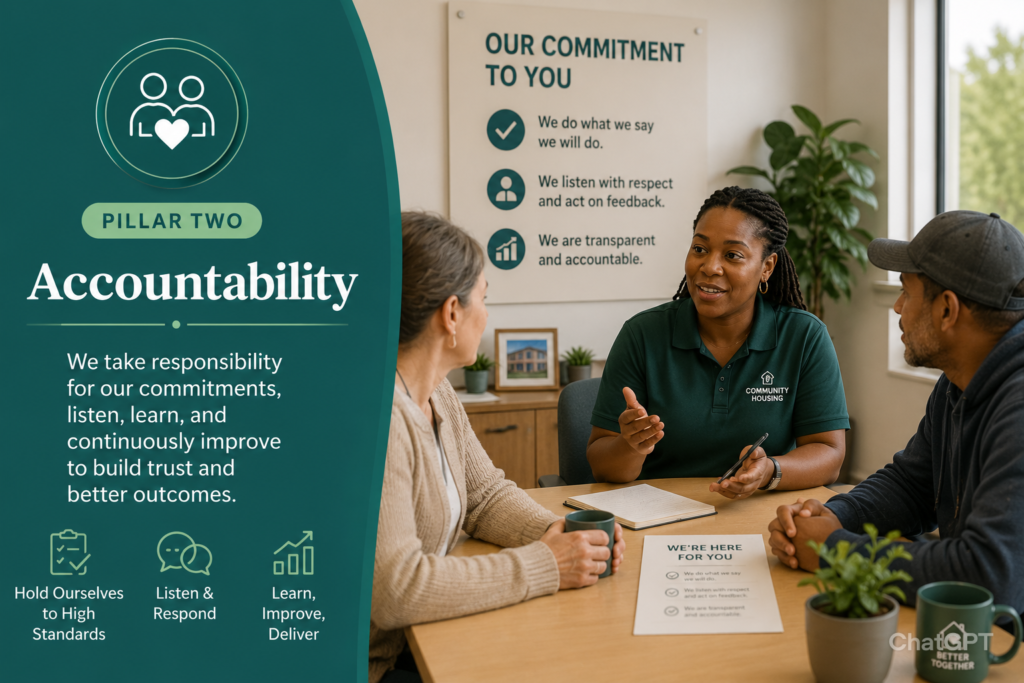
Pillar Two — Accountability
Accountability gets misunderstood more than any other element of supportive housing. Some people hear the word and think punishment. Rules for the sake of rules. Consequences designed to catch people out.
That is not what accountability means in an effective supportive housing model. Real accountability is protective, not punitive. It exists to support residents, not to control them.
Here is what genuine accountability looks like in practice at Hazel’s Tranquility Place:
Clear Expectations From Day One
Every resident who enters our program understands what is expected of them from the moment they arrive. House rules, daily schedule, behavioral expectations, and participation requirements are communicated clearly and transparently. There are no hidden standards. No moving goalposts. No surprises.
This clarity matters because ambiguity is itself a stressor for people in early recovery or post-crisis stabilization. Knowing exactly what is expected reduces anxiety and gives residents a framework they can actually succeed within.
Consistent, Fair Enforcement
Rules that are selectively enforced are not really rules at all. They are a source of confusion and resentment. At Hazel’s Tranquility Place, expectations apply equally to every resident and staff members enforce them with consistency and fairness.
Consistent enforcement serves a deeper purpose than maintaining order. It models the cause-and-effect relationships that life outside the program will demand. Residents who experience fair, consistent accountability inside the program are building the internal framework that helps them navigate accountability in employment, family relationships, and community life.
Accountability to Each Other
One of the most powerful sources of accountability in a structured housing program is the peer community itself. Residents who live alongside each other, share meals, attend house meetings together, and navigate the same daily expectations develop a genuine sense of mutual responsibility.
This peer accountability is not enforced by staff. It grows organically from shared experience and shared investment in the community. According to research published by the Journal of Substance Abuse Treatment, peer accountability in residential settings is one of the strongest predictors of sustained sobriety and long-term housing retention among vulnerable adults.
Accountability to the Broader Care Team
For residents working with probation officers, case managers, or behavioral health providers, accountability extends beyond the walls of the house. At Hazel’s Tranquility Place, we maintain active communication with each resident’s care team so that accountability is consistent across every system the resident is engaged with.
Our referral partners, including those coordinated through our sister organization Solano Impact Care, remain informed and involved throughout each placement. Nothing falls through the cracks between systems.
Call Now: 707-301-4051
Pillar Three — Long-Term Stability
Safety and accountability create the conditions for something more important than either of them individually. They create the conditions for genuine long-term stability.
This is where the work of supportive housing moves from crisis management to life building. And it is the pillar that most clearly separates programs that produce lasting change from those that simply move people from one temporary situation to the next.
Long-term stability in a supportive housing context involves several interconnected dimensions.
Housing Stability
The most immediate dimension is securing stable, permanent housing as a next step after the program. From day one at Hazel’s Tranquility Place, our team works with each resident on a transition plan that identifies realistic, appropriate permanent housing options and builds toward them actively throughout the placement.
The goal is never simply to discharge someone. The goal is to transition them with intention, support, and a real plan in place.
Health Stability
Long-term stability requires that residents leave our program with their health managed, their medications consistent, and their clinical care connections intact. We actively coordinate with behavioral health providers, primary care physicians, and treatment programs throughout each placement so that health supports do not disappear the moment a resident transitions out.
The Centers for Disease Control and Prevention identifies stable housing as one of the most powerful social determinants of health, noting that housing instability is directly linked to higher rates of chronic disease, mental health deterioration, and emergency service utilization. Supportive housing that prioritizes health stability is therefore a public health intervention as much as a social services one.
Financial Stability
People cannot maintain housing without income. During a placement at Hazel’s Tranquility Place, we actively support residents in enrolling in benefits they qualify for, including Medi-Cal, CalFresh, and SSI/SSDI where applicable, and in building the employment readiness skills that move them toward earned income over time.
Relational Stability
Isolation is one of the most reliable predictors of relapse and crisis recurrence among vulnerable adults. Long-term stability requires connection, to family where relationships can be rebuilt safely, to community, to peers who support rather than undermine recovery, and to the professional networks that provide ongoing guidance.
Our work with Solano Impact Care extends into this dimension. Their community resource navigation and resilience-building programs connect residents to the social fabric of Solano County in ways that outlast any single housing placement.
For a deeper look at how structured housing builds toward these dimensions of stability, our article on Benefits of Structured Housing for Adults in Transition in Solano County covers the evidence and the practical mechanisms in detail.
Call Now: 707-301-4051
How the Three Pillars Work Together
Understanding each pillar individually is useful. Understanding how they function together is where the real insight lives.
Safety without accountability produces comfort without growth. A person can feel safe in an environment and still drift, avoid hard work, and make choices that undermine their long-term wellbeing. Safety is necessary but not sufficient.
Accountability without safety produces compliance without healing. When people are held to expectations in an environment where they do not feel genuinely safe, they perform rather than transform. They follow rules out of fear rather than build habits out of genuine investment. The moment accountability structures are removed, the behavior reverts.
Stability without safety and accountability is fragile. Housing and resources alone do not produce lasting change if the person has not developed the internal and social foundations to sustain them. Countless individuals have been placed in permanent housing only to lose it within months because the stabilization work was never done.
When all three pillars operate together, something different happens. Safety creates the conditions for genuine engagement. Accountability builds the habits and relationships that growth requires. And long-term stability becomes not just a goal but an achievable, sustainable reality.
This is the model at Hazel’s Tranquility Place. It is not complicated. But it requires genuine commitment to all three pillars consistently, every day, for every resident.
What This Looks Like Day to Day at Hazel’s Tranquility Place
Theory is only useful if it translates into practice. Here is what the three-pillar model looks like inside our program on an ordinary day:
Morning: Residents wake to a consistent daily schedule. Mealtimes are set. The day is structured from the start, which reduces the anxiety and drift that unstructured mornings can produce for people in early stabilization.
During the Day: Programming blocks cover life skills, goal setting, and personal development. Residents attend outpatient appointments with transportation support where needed. Staff check in individually with residents, building the relational trust that makes accountability feel supportive rather than threatening.
House Meetings: Regular house meetings bring the community together to address shared expectations, celebrate progress, and navigate any tensions within the community constructively. These meetings build the communication skills and collective accountability that residents carry with them after they leave.
Care Coordination: Our team communicates with referring professionals throughout each placement. Case managers receive updates. Probation officers are notified promptly of anything relevant to supervision compliance. Behavioral health providers stay informed of any changes in a resident’s condition or needs.
Transition Planning: Throughout the placement, staff work with each resident on their individual transition plan. Housing options are researched. Benefits are enrolled. Employment connections are built. The next chapter is being prepared for actively, not left to figure out on the last day.
Who Benefits Most From This Model
The safety accountability stability supportive housing model at Hazel’s Tranquility Place is designed for adults in Solano County who are ready to engage with a structured residential community and committed to moving toward stability.
The people who benefit most include:
- Adults leaving hospitals or psychiatric facilities who need a structured post-discharge environment with professional oversight
- Individuals in recovery from substance use disorder who cannot safely return to previous living situations
- Justice-involved adults rebuilding their lives after incarceration who need verified stable housing and accountability structures aligned with supervision requirements
- Adults managing serious mental illness or co-occurring conditions who need daily support and clinical coordination
- Individuals who have cycled through crisis services repeatedly without achieving lasting stability
- Families whose loved ones need a level of professional, structured support that the family home cannot reliably provide
For families reading this and recognizing their loved one in that list, the most important step is reaching out before the crisis point rather than after it. Hazel’s Tranquility Place accepts referrals from families directly. You do not need a professional intermediary to start the conversation.
Call Now: 707-301-4051
Safe, Accountable, and Built for the Long Term
The three pillars of safety, accountability, and long-term stability are not ideals that Hazel’s Tranquility Place aspires to. They are the practical, daily reality of how our program operates across our three Solano County facilities.
Every family member who has watched a loved one cycle through crisis deserves to know that programs exist that do more than temporarily interrupt that cycle. Hazel’s Tranquility Place was built to break it. The safety accountability stability supportive housing model we deliver is grounded in evidence, shaped by compassion, and committed to every single resident’s genuine long-term success.
If someone you care about is approaching a transition right now, do not wait for the next crisis to act. Reach out today. Our team is ready to answer your questions, check availability at our Vallejo and Fairfield locations, and help you find the right next step.
Visit hazelstranquility.org or email info@hazelstranquility.org to submit a referral or learn more about our program.
Frequently Asked Questions
Yes, families can contact Hazel’s Tranquility Place directly at 707-301-4051 or through hazelstranquility.org and our team will walk you through the referral process from start to finish with honesty and care.
The consistent integration of all three pillars, safety, accountability, and long-term stability, into a unified daily residential model, combined with our active partnership with Solano Impact Care and our three Solano County locations, means that residents receive a level of coordinated, comprehensive support that is genuinely difficult to find elsewhere in the county.
Solano Impact Care, our sister organization at solanoimpactcare.org, provides wraparound care coordination including comprehensive care management, trauma-informed support, and community resource navigation that strengthens all three pillars from outside the residential setting.