
When families search for a housing program for a vulnerable adult, they encounter a lot of language that sounds reassuring but does not actually tell them very much. Safe environment. Nurturing atmosphere. Supportive setting. These phrases appear on almost every program website and brochure. But what do they actually mean? What does a safe and nurturing housing environment look like on a Tuesday morning? What does it feel like to a person who arrives scared, exhausted, and uncertain about what comes next?
These are the right questions to ask. Because the difference between a program that uses these words and one that actually delivers on them is significant. And for a vulnerable adult at a critical turning point, that difference can determine whether a placement produces genuine stability or simply a temporary interruption in a continuing crisis.
At Hazel’s Tranquility Place, a safe nurturing housing environment for vulnerable adults is not a marketing phrase. It is a deliberate, specific commitment that shapes every aspect of how our program operates. This article defines what that means concretely, across every dimension of residential life, so that families and professionals can evaluate programs with genuine clarity rather than relying on language alone.
Call Now: 707-301-4051
Why the Environment Matters as Much as the Services
Before defining what a safe and nurturing housing environment looks like, it helps to understand why the environment itself is so important to recovery and stabilization outcomes.
Clinical treatment addresses the medical and psychological dimensions of a person’s condition. But the environment in which someone lives operates on a different level. It shapes the nervous system’s baseline state. Also, it determines the quality and consistency of sleep. It influences the social interactions a person has every day. It either reinforces or undermines the habits and skills that clinical treatment is trying to build.
Research from the National Institute of Mental Health shows that residential environment directly affects treatment engagement, medication adherence, and emotional regulation capacity among adults with serious mental illness. The Urban Institute identifies stable, safe housing as one of the most significant social determinants of long-term health outcomes across all adult populations.
For vulnerable adults specifically, the stakes are even higher. Many residents of supportive housing programs carry histories of unsafe, chaotic, or traumatic living environments. The residential setting they enter during a critical transition is not just a backdrop to their recovery. It is an active variable in whether that recovery happens at all.
A safe nurturing housing environment for vulnerable adults is therefore not a luxury or an amenity. It is a clinical necessity.
What Physical Safety Actually Looks Like
Physical safety is the most basic dimension of a residential environment and the one that should never be assumed. Here is what genuine physical safety looks like in a supportive housing program.
The facility itself is clean, well-maintained, and functional
A residential program that operates in a deteriorating, poorly maintained facility sends a message to residents before a single word is spoken. It communicates that the people living there are not worth investing in. At Hazel’s Tranquility Place, our facilities across Glen Cove Vallejo, Cordelia Fairfield, and Woodcreek Fairfield are maintained to a standard that communicates the opposite. Clean, functional, and genuinely cared for.
The environment is free from substances and dangerous influences
For adults in recovery or managing psychiatric conditions, the presence of substances or individuals who undermine recovery in a residential setting is not just uncomfortable. It is dangerous. A safe housing environment maintains clear, consistently enforced expectations about substances and behavior that protect every resident in the community.
Residents feel physically secure
Physical security means that residents do not feel threatened by other residents, by staff, or by the broader environment of the home. It means conflict is addressed promptly and professionally when it arises. It means staff are present, attentive, and trained to de-escalate situations before they become safety concerns.
The neighborhood context supports rather than undermines recovery
The surrounding neighborhood matters. Our residential locations at Hazel’s Tranquility Place are situated in stable, residential areas that provide calm surroundings and appropriate distance from high-risk environments. This is not incidental. It is a deliberate aspect of how we have designed our program’s physical presence in Solano County.
What Emotional Safety Actually Looks Like
Physical safety is necessary but not sufficient. For vulnerable adults who have frequently experienced unsafe, unpredictable, or dehumanizing environments, emotional safety is often the dimension that matters most to their capacity to engage with recovery.
Emotional safety in a residential program looks like this:
Staff who engage with genuine respect
The way staff speak to and about residents communicates everything about the program’s actual values. In a genuinely safe and nurturing housing environment, staff address residents by name, engage with genuine curiosity rather than judgment, and respond to difficult behavior with understanding rather than punitive reactions.
At Hazel’s Tranquility Place, our staff approach comes from the founding belief of Councilwoman K Patrice Williams that every person deserves dignity regardless of their history or circumstances. That belief is not a policy statement. It is the lived standard that shapes every staff interaction.
Predictability and consistency that build trust
For adults with trauma histories, unpredictability is itself a source of fear. A residential environment where rules change without warning, where staff responses are inconsistent, or where expectations shift depending on who is working creates chronic low-grade anxiety that undermines recovery.
Emotional safety requires consistency. The same expectations, communicated in the same way, enforced by all staff with the same degree of fairness. At Hazel’s Tranquility Place, house expectations are clear from day one and applied consistently across every resident and every staff member.
Freedom from shame
Many vulnerable adults arrive at a supportive housing program carrying significant shame about the circumstances that led them there. A safe and nurturing housing environment actively counteracts that shame by treating residents as capable human beings with futures worth investing in rather than problems to be managed or contained.
This means no humiliating house practices. No dehumanizing language. No policies that communicate to residents that they are less than fully worthy of respect. These are not small things. They are the conditions under which genuine healing becomes possible.
Space for difficulty without punishment
Recovery is not linear. People have hard days. Emotions surface. Old patterns reassert themselves. A genuinely nurturing environment holds space for that difficulty without treating it as a failure or a reason for punishment. Staff who respond to a resident’s hard day with curiosity and support rather than discipline create the conditions for honest engagement that rigid, punitive environments cannot.
Call Now: 707-301-4051
What a Nurturing Environment Looks Like in Daily Practice
Nurturing is another word that sounds good but requires concrete definition to be meaningful. Here is what a nurturing housing environment actually looks like in the daily rhythms of residential life at Hazel’s Tranquility Place.
Mealtimes that feel communal rather than institutional
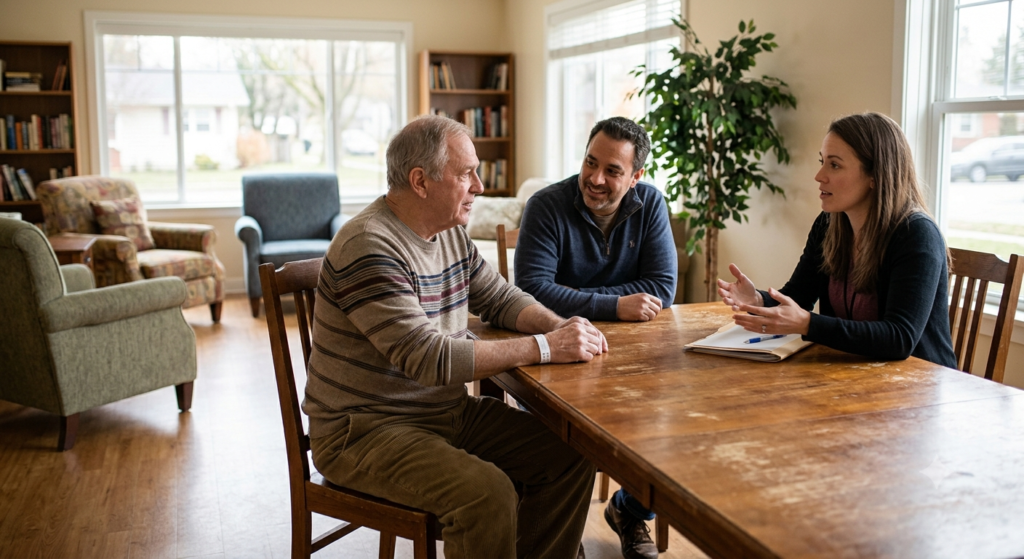
Shared meals are one of the most powerful elements of residential community life. At Hazel’s Tranquility Place, mealtimes are structured and consistent but they are also genuinely communal. Residents eat together. Conversations happen. The shared table is itself a therapeutic space where connection, normalcy, and belonging are practiced every day.
Programming that treats residents as capable adults
Life skills programming at Hazel’s Tranquility Place is designed to build genuine capacity rather than simply fill time. Residents are treated as adults with agency and intelligence who are developing skills, not as passive recipients of services. This distinction matters more than it might seem. Adults who are treated as capable tend to behave as capable. Adults who are managed and directed without agency tend to disengage.
Individual attention that goes beyond case management
In a nurturing residential environment, staff know their residents as people. They know what each person is working toward. Likewise, they notice when someone is having a harder week. They celebrate when someone reaches a milestone. This individual attention is not a function of clinical training alone. It is a function of genuine care and the organizational culture that makes genuine care possible.
A peer community that supports rather than undermines
The culture among residents themselves is part of the nurturing environment. At Hazel’s Tranquility Place, we actively cultivate a peer community of mutual support and accountability. Residents who have been in the program longer often become informal anchors for newer residents. Shared experience creates genuine solidarity that professional support alone cannot replicate.
What Families Should Look for When Evaluating a Program
If you are a family member evaluating a supportive housing program for a loved one, here is a practical checklist of what a genuinely safe and nurturing housing environment for vulnerable adults should look like when you ask the right questions.
Ask about physical environment:
- Can you describe the facility and the surrounding neighborhood?
- How do you maintain cleanliness and upkeep across the home?
- What policies exist around substances and safety?
Also, ask about staff culture and approach:
- How do staff respond when a resident is having a difficult day behaviorally?
- What training do staff receive in trauma-informed practice?
- How do you handle conflict between residents?
Ask about daily life:
- What does a typical day look like for a resident?
- How do mealtimes work?
- What does individual attention from staff look like day to day?
Ask about dignity and respect:
- How do you communicate house expectations to new residents?
- What does your enforcement process look like when a rule is violated?
- How do you actively counteract shame and stigma in your program culture?
The answers to these questions will tell you far more about a program’s actual culture than any language on a website. At Hazel’s Tranquility Place, we welcome these questions and will answer all of them directly and honestly.
Call Now: 707-301-4051

Why Hazel’s Tranquility Place Was Built Around This Standard
Hazel’s Tranquility Place was founded in 2019 by Fairfield Councilwoman K Patrice Williams after she witnessed firsthand the gap between what vulnerable adults in Solano County needed and what the available residential options were actually providing. She named the program after her own mother and built it around a belief that is simple to articulate and harder to consistently deliver.
Every person who walks through our doors deserves a safe, nurturing environment where they are treated with dignity and given a genuine opportunity to move forward with stability.
That standard is not aspirational. It is operational. It shows up in how our facilities are maintained, how our staff are trained, how our daily programming is designed, how our house expectations are communicated and enforced, and how we think about every resident’s experience from the moment they arrive.
Our coordination with Solano Impact Care extends this nurturing approach beyond the residential walls through trauma-informed support, comprehensive care management, and community resource navigation that wraps additional layers of professional care around every resident’s journey.
For families wondering what their loved one’s daily experience will actually look like, our article on what families can expect when referring a loved one to Hazel’s Tranquility Place answers that question in detail.
Final Thoughts
Every family member searching for a housing program for a vulnerable adult deserves to know exactly what they are choosing. Not reassuring language. Not marketing phrases. The concrete, specific reality of what daily life inside a program looks and feels like for the person they love.
A safe nurturing housing environment for vulnerable adults at Hazel’s Tranquility Place means clean, well-maintained facilities in stable neighborhoods. Staff who engage with genuine dignity and respect. Consistent, predictable expectations enforced with fairness. Daily programming that treats residents as capable adults. A peer community that supports rather than undermines. And an organizational culture that takes seriously the responsibility of being a safe haven for people at one of the most vulnerable moments of their lives.
If you want to talk about whether our program is the right environment for someone you care about, we are ready to have that conversation honestly.
Call Now: 707-301-4051
Visit hazelstranquility.org or email info@hazelstranquility.org to learn more or submit a referral today.