
Behavioral health providers across Solano County face a challenge that clinical training alone cannot solve. You can prescribe the right medication, deliver the right therapy and build a comprehensive treatment plan. But if your patient goes home to an unsafe, unstable, or unsupported living environment, the clinical work you have done starts to unravel almost immediately.
Housing is not a peripheral concern in behavioral health care. It is a core determinant of whether treatment actually sticks. Patients who lack stable, structured living arrangements miss appointments at higher rates, discontinue medications more frequently, and experience psychiatric crises that send them back through emergency services at significant cost to everyone involved.
Behavioral health housing in Solano County addresses this gap directly. It brings together safe residential care and wraparound behavioral health support in a single, coordinated environment. At Hazel’s Tranquility Place, we work alongside behavioral health providers, case managers, and psychiatrists to ensure that the patients you serve have the residential foundation they need to make real, lasting progress in their treatment.
This guide explains how that partnership works and how to access it.
Submit a Referral — hazelstranquility.org
Where Behavioral Health and Housing Stability Meet
Stable housing and behavioral health are deeply connected. Providers who work with adults managing serious mental illness, co-occurring disorders, or complex psychosocial challenges already know this from direct clinical experience. Research consistently confirms what the front lines reveal every day.
Here is what the evidence shows about behavioral health and housing instability:
- Adults with serious mental illness experience homelessness at rates far exceeding the general population
- Housing instability directly worsens psychiatric symptoms by increasing chronic stress, disrupting sleep, and eliminating predictable daily structure
- Unstable living environments interfere with medication adherence, one of the most critical factors in managing conditions like schizophrenia, bipolar disorder, and major depressive disorder
- Repeated psychiatric hospitalization is significantly more common among patients who lack safe housing between episodes
- Social isolation, which is prevalent among unhoused or precariously housed individuals, accelerates cognitive and functional decline in adults with behavioral health conditions
- Adults with co-occurring substance use disorders face compounded risk when they return to environments where triggers and substances are present
Consequently, behavioral health housing in Solano County is not a social service add-on. It is a clinical necessity. When providers treat the diagnosis without addressing the residential environment, they are solving only part of the problem.
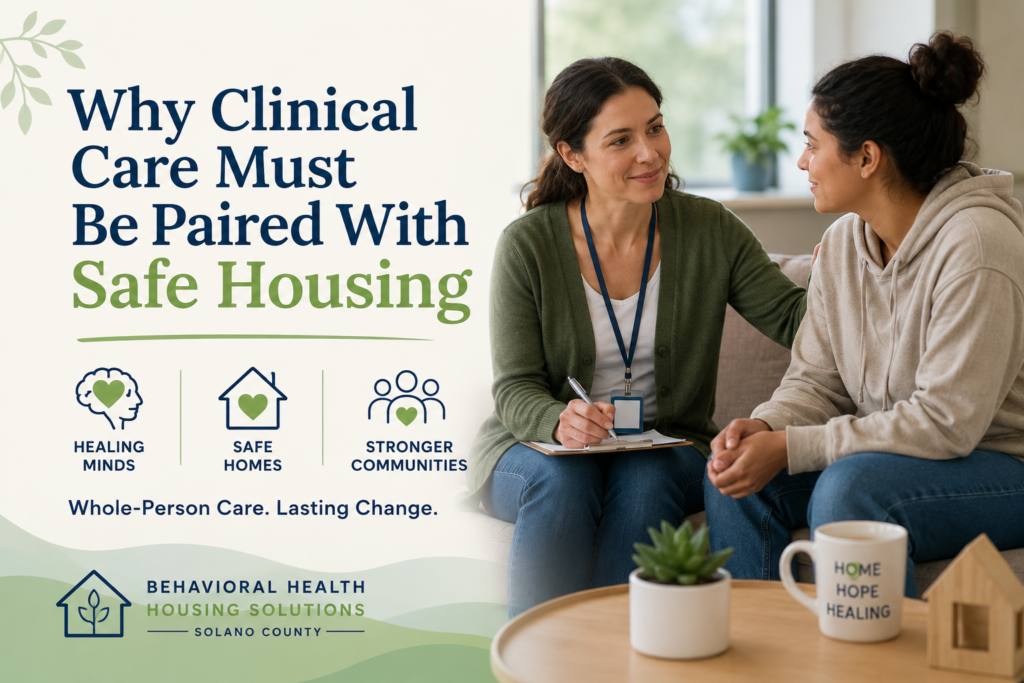
Why Clinical Care Must Be Paired With Safe Housing
Consider what actually happens when a patient with serious mental illness is discharged from inpatient care without appropriate residential support. The treatment team has worked hard to stabilize the person. Medications have been adjusted. A follow-up plan has been established. Then the patient returns to a chaotic home environment, misses the first follow-up appointment, stops taking medications within two weeks, and presents at the emergency department within a month.
This pattern is not rare. It is one of the most documented failure modes in behavioral health care. Furthermore, it is largely preventable when clinical care is coordinated with appropriate residential placement.
Here is why pairing clinical care with safe housing produces better outcomes:
- Medication management becomes sustainable. Trained residential staff support medication adherence daily, catching missed doses before they become crises rather than after.
- Treatment plans stay on track. Residents in structured housing attend follow-up appointments at higher rates because transportation, reminders, and scheduling support are built into the residential program.
- Psychiatric symptoms stabilize faster. A calm, predictable, safe environment actively reduces the environmental stressors that exacerbate psychiatric symptoms.
- Crisis episodes decrease significantly. When behavioral warning signs are identified early by trained residential staff and communicated promptly to the clinical team, interventions happen before situations escalate.
- Providers gain a reliable partner in monitoring. Clinical teams cannot observe patients 24 hours a day. Trained residential staff who communicate consistently with the treatment team extend clinical oversight into daily residential life.
- Patients build trust and engagement. Stability breeds engagement. Patients who feel safe and supported are more likely to participate actively in their treatment and more likely to maintain that engagement over time.
Behavioral health housing in Solano County that operates as a genuine clinical partner — rather than simply a place for patients to sleep — transforms the treatment relationship entirely.
Submit a Referral — hazelstranquility.org
How Hazel’s Tranquility Place Collaborates With Behavioral Health Partners
Hazel’s Tranquility Place does not operate as a standalone residential program. Instead, we function as an active partner within each resident’s behavioral health care system. Providers who refer patients to our program remain central to the care relationship throughout the placement.
Here is specifically how we collaborate with behavioral health partners:
Psychiatrists and Prescribing Providers
- We maintain an accurate, up-to-date medication list for every resident and flag any adherence concerns directly to the prescribing provider
- Our staff administer and document medications according to each resident’s prescribed protocol
- We contact prescribing providers promptly when a resident displays symptoms suggesting a need for medication review or adjustment
- We coordinate scheduling for psychiatric appointments and provide transportation support to reduce missed visits
Outpatient Therapists and Counselors
- We actively support residents in attending all scheduled therapy appointments
- Our staff maintain communication with each resident’s therapist regarding behavioral observations that may be relevant to clinical work
- We ensure that the residential environment reinforces rather than conflicts with therapeutic goals
- Additionally, we participate in collaborative care conversations when the treatment team requests our input
Case Managers and Care Coordinators
- We provide regular updates on resident progress, behavioral patterns, and any changes in functional status
- Our team participates in case conferences and care coordination meetings as needed
- We share documentation with care coordinators to support benefit reviews, housing transitions, and treatment plan updates
- Moreover, we align our internal programming with the goals and priorities established in each resident’s individualized care plan
Crisis Teams and Emergency Services
- When a resident experiences a behavioral health crisis, we contact the appropriate clinical providers and, where necessary, emergency services immediately
- Our staff are trained in de-escalation and crisis response protocols
- Furthermore, we document all crisis incidents and share that documentation with the resident’s care team in a timely manner
Behavioral health housing in Solano County works best when the residential provider is a genuine extension of the clinical team. That is the standard we hold ourselves to at Hazel’s Tranquility Place.
Who We Serve: Identifying the Right Referral
Hazel’s Tranquility Place provides behavioral health housing in Solano County for adults who need a structured, supervised residential environment alongside ongoing clinical care. Our program fills the critical space between inpatient treatment and fully independent living.
The following individuals are strong candidates for referral:
- Adults transitioning from inpatient psychiatric hospitalization who are not clinically ready for independent living
- Patients with serious mental illness such as schizophrenia, schizoaffective disorder, bipolar disorder, or treatment-resistant depression who require daily residential support
- Adults managing co-occurring mental health and substance use disorders who need a structured, supervised environment
- Patients who have a documented history of repeated psychiatric hospitalizations linked to housing instability
- Adults with acquired brain injuries or cognitive impairments that affect daily functioning and require residential oversight
- Individuals whose home environment actively undermines their psychiatric stability and treatment engagement
- Patients whose families are unable to provide a safe and appropriately supportive residential situation
Importantly, our program serves adults who are medically stable and do not require inpatient or locked-facility-level care. If you are unsure whether a specific patient meets our criteria, contact us directly. We will review the clinical picture with you and give you an honest answer about fit.
Submit a Referral — hazelstranquility.org
Ensuring Continuity of Care for Every Resident
One of the most significant risks in any care transition is the loss of clinical continuity. Patients who move from inpatient care to a residential setting without strong information transfer and ongoing provider communication are vulnerable to gaps that can quickly become crises.
At Hazel’s Tranquility Place, we treat continuity of care as a non-negotiable operational standard. Here is how we protect it at every stage:
At Intake
- We conduct a thorough intake review using the clinical summary, discharge documentation, and medication list provided by the referring team
- Our staff review discharge instructions carefully and implement recommendations from the treating provider immediately upon admission
- We establish contact with every provider on the resident’s care team during the intake process so that communication channels are open from day one
- Additionally, we identify any gaps in care coverage and work with the case manager to address them before they become problems
During the Placement
- Residential staff conduct daily check-ins with each resident and document behavioral observations relevant to clinical monitoring
- We hold regular internal care reviews to assess resident progress and identify any emerging concerns
- Concerns are communicated to the appropriate clinical provider promptly rather than held until a scheduled meeting
- Furthermore, we coordinate all specialist appointments, medication refills, and lab work to prevent treatment plan interruptions
At Transition
- Transition planning begins well before a resident’s projected move-out date
- We work with the clinical team to confirm that ongoing outpatient care is in place before a resident departs
- Our staff assist with applications for permanent supportive housing, linkage to community mental health services, and other long-term supports
- Finally, we provide a detailed transition summary to the receiving provider or housing program so that the handoff is complete and documented
Behavioral health housing in Solano County that prioritizes continuity of care protects patients at their most vulnerable transitions and gives clinical teams genuine confidence in the placement.
What Providers Need to Know Before Making a Referral
Before referring a patient to behavioral health housing in Solano County at Hazel’s Tranquility Place, here is the practical information providers need:
Our program is appropriate for patients who:
- Are 18 years of age or older
- Are medically stable at the time of admission
- Do not require inpatient, locked-facility, or skilled nursing-level care
- Are willing to participate in a structured community residential setting
- Have a primary behavioral health condition driving the housing need
Our program is not appropriate for patients who:
- Require 24-hour medical nursing supervision
- Present an active, imminent danger to others that cannot be safely managed in a community setting
- Are currently in acute psychiatric crisis requiring inpatient stabilization
- Require detox or medically supervised withdrawal at the time of referral
What to prepare before contacting us:
- Patient demographics and current location
- Primary psychiatric diagnoses and relevant history
- Current medication list and prescribing provider contact information
- Most recent clinical or discharge summary
- Functional assessment including activities of daily living capacity
- Behavioral history relevant to a community residential setting
- Insurance or funding source information
- Case manager or care coordinator contact details
Submit a Referral — hazelstranquility.org
How Providers Can Check Immediate Bed Availability
Timing matters in behavioral health care transitions. Delays in securing appropriate residential placement after hospitalization increase the risk of deterioration, readmission, and disengagement from treatment. Therefore, we have designed our referral process to be as fast and straightforward as possible.
Here is how to check bed availability and move a referral forward:
Step 1 — Submit a referral online or call directly
Visit hazelstranquility.org to submit a referral form, or call our team directly to discuss current availability. Submitting early in the discharge planning process gives us the most time to prepare for a smooth transition.
Step 2 — Provide a clinical summary
Share the clinical information outlined in the previous section. The more complete the picture you give us at the outset, the faster we can assess fit and confirm availability.
Step 3 — Receive a response within one business day
Our team reviews all referrals promptly. In most cases, we provide a clear response on fit and availability within one business day of receiving a complete referral.
Step 4 — Confirm placement and coordinate the transition
Once placement is confirmed, we work directly with your team to coordinate the handoff. This includes reviewing discharge instructions, establishing care team contacts, and preparing the resident for arrival.
Step 5 — Stay connected after admission
After admission, your team will have a named point of contact at Hazel’s Tranquility Place for ongoing communication. We do not go silent after placement. We stay engaged with the clinical team throughout the resident’s time in our program.
Behavioral health housing in Solano County that is responsive and communicative makes the entire care system work better. That is what we are committed to providing.
Submit a Referral — hazelstranquility.org
Frequently Asked Questions
Q: What types of behavioral health diagnoses does Hazel’s Tranquility Place have experience supporting?
Our team has direct experience supporting adults with schizophrenia, schizoaffective disorder, bipolar disorder, major depressive disorder, PTSD, co-occurring mental health and substance use disorders, and acquired brain injuries.
Q: How does Hazel’s Tranquility Place handle a psychiatric crisis that occurs during a resident’s placement?
Our trained staff follow documented crisis response protocols, contact the resident’s clinical providers immediately, and coordinate with emergency services when needed to ensure the resident receives the appropriate level of care as quickly as possible.
Q: Can a referring psychiatrist or therapist continue to provide clinical care after a patient is placed at Hazel’s Tranquility Place?
Yes, we actively support and encourage continuity with existing providers because maintaining established therapeutic relationships is one of the most important protective factors during a housing transition.
Q: What funding sources does Hazel’s Tranquility Place accept for behavioral health housing placements?
We accept Medi-Cal, SSI/SSDI, county-funded programs, and private pay arrangements, and our team works with referring providers during the intake process to identify the most appropriate funding pathway for each specific resident.
Q: How quickly can a bed be secured for a patient approaching discharge?
We review complete referrals within one business day and prioritize discharge-related placements, so contacting us as early as possible in the discharge planning process gives us the best opportunity to confirm availability and prepare for a smooth transition.
The Bottom Line for Behavioral Health Providers
Every treatment plan your team builds deserves a residential environment that supports it. Behavioral health housing in Solano County at Hazel’s Tranquility Place gives your patients exactly that — a structured, safe, clinically coordinated residential setting where the work of treatment can actually take hold.
We are here to be a genuine partner in the care of your most complex patients. Not a handoff destination. Not a waiting room. A real, active partner in moving people toward stability.
If you have a patient approaching discharge or transition who needs behavioral health housing in Solano County, reach out today.
Submit a Referral — hazelstranquility.org