
When someone you love is approaching a major transition, whether after a hospitalization, a period of incarceration, or a stretch of housing instability, one of the most important decisions you will face is what level of housing support they actually need right now.
Two options that come up consistently in those conversations are supportive housing and independent living. On the surface, both involve having a place to live. But underneath that surface, they are fundamentally different in terms of what they provide, who they are designed for, and what outcomes they produce for vulnerable adults at different stages of their journey.
Choosing the wrong level of care is one of the most common reasons housing placements fail. Moving someone to independent living before they are genuinely ready produces the same result as not helping them at all. And keeping someone in a structured program longer than they need it delays the independence that is the whole point of the journey.
This article defines both options clearly, explains the key differences, and gives families, individuals, and professionals a practical framework for deciding which is right for a specific person at a specific moment.
Call Now: 707-301-4051
What is Supportive Housing?
Supportive housing is a residential model that combines stable housing with structured programming and professional support services integrated into daily life. It is not just a place to live. It is a living environment deliberately designed to help adults with complex needs stabilize, build skills, and move toward independence.
At Hazel’s Tranquility Place, supportive housing across our three Solano County facilities includes:
- A structured daily schedule with consistent mealtimes, programming blocks, and curfew
- Professional staff present and actively engaged throughout the day
- Hands-on medication management support
- Individualized life and stability planning from day one
- Active coordination with behavioral health providers, case managers, and other clinical professionals
- Life skills development covering budgeting, cooking, communication, and employment readiness
- Peer community of residents navigating similar transitions
- Transition planning that prepares residents for what comes next throughout the entire placement
The defining feature of supportive housing is that the support is built into the residential environment itself. Residents do not have to seek out services separately and navigate them independently. The services come to them as an integrated part of daily life.
Supportive housing is designed for adults who need more than shelter but do not require inpatient or locked-facility-level care. It sits in the critical space between acute crisis services and fully independent living.
What is Independent Living?
Independent living means maintaining a home, managing daily responsibilities, and navigating life without residential support structures in place. It is the goal that most vulnerable adults and their families are working toward. It is also a level of functioning that requires specific readiness across multiple dimensions simultaneously.
Independent living requires a person to:
- Manage their own medication consistently without daily oversight
- Pay rent and manage household finances reliably
- Attend medical and mental health appointments without support or reminders
- Maintain a household including cooking, cleaning, and basic upkeep
- Navigate relationships and community life without structured peer support
- Recognize and respond to early warning signs of their own deterioration before they become crises
- Access community resources independently when needs arise
None of these requirements is unreasonable. Most adults manage them without a second thought. But for someone who has just left a hospital, a treatment program, or a period of incarceration, attempting all of these things simultaneously without a structured intermediate step is one of the most reliable predictors of placement failure and return to crisis.
Independent living is not a reward for good behavior. It is a readiness threshold. And reaching that threshold genuinely requires the foundation that supportive housing builds.
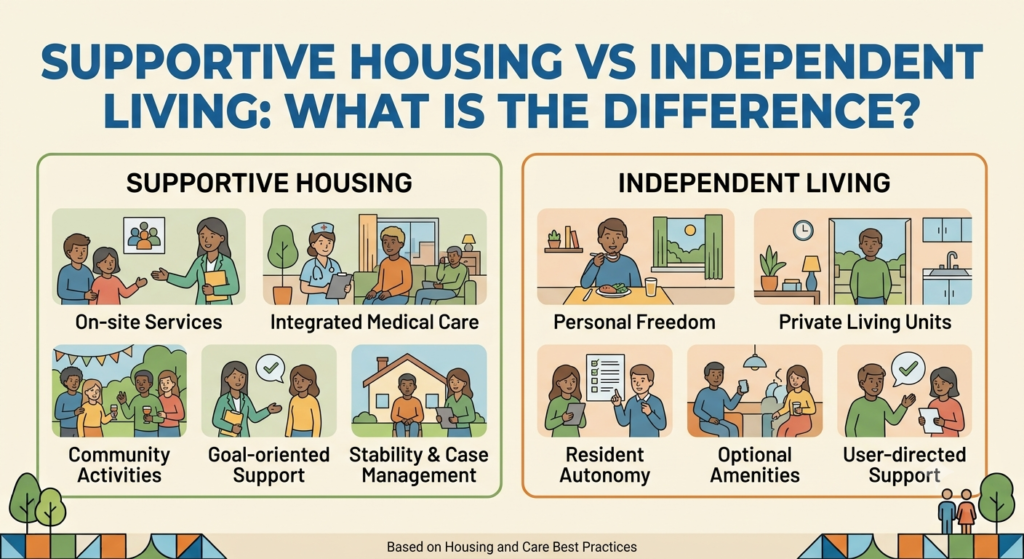
The Key Differences Side by Side
Here is a direct comparison of supportive housing and independent living across the dimensions that matter most for vulnerable adults and the people who support them.
Structure and routine
Supportive housing provides a structured daily environment with set schedules, house expectations, and consistent professional oversight. Independent living offers complete freedom to structure one’s own time, which is valuable when someone is ready for it and destabilizing when they are not.
Professional support
Supportive housing integrates professional staffing, medication management, behavioral health coordination, and care planning into daily residential life. Independent living does not include any of these by default. Whatever clinical support exists in independent living comes from external outpatient services that the individual must access and maintain on their own.
Medication management
In supportive housing, trained staff organize medications, monitor adherence daily, and communicate with prescribing providers when concerns arise. In independent living, the individual manages their own medications completely independently. For adults with serious mental illness, co-occurring disorders, or complex medication regimens, this distinction alone is often the difference between stability and crisis.
Peer community
Supportive housing provides a built-in community of peers navigating similar transitions. That community creates accountability, normalizes the recovery process, and provides genuine mutual support. Independent living means building a social network from scratch, which is harder and slower than it sounds for adults who have been through significant social disruption.
Cost and funding
Supportive housing placements are often funded through Medi-Cal, SSI/SSDI, county-funded programs, or other social service funding streams. Independent living costs are typically borne by the individual through income, benefits, or family support. For adults without stable income or reliable benefits, the financial access to independent housing can be a significant barrier.
Who it is designed for
Supportive housing is designed for adults who are medically stable but not yet ready to manage all the demands of independent life without daily professional support. Independent living is appropriate for adults who have developed the skills, resources, and support networks to sustain stability on their own terms.
Call Now: 707-301-4051
The Danger of Skipping the Supportive Housing Step
One of the most consistent findings in housing research is that moving vulnerable adults directly from a crisis situation to independent living without an intermediate structured step produces poor long-term outcomes.
Here is what tends to happen when the supportive housing step is skipped:
- Medication non-adherence develops quickly without daily support structures and psychiatric stability deteriorates within weeks
- Unstructured time creates vulnerability to old patterns, substance use, and crisis behavior that structured programming would have interrupted
- Practical demands of independent living, paying bills, managing a household, accessing services, overwhelm someone whose capacity for these tasks has not been rebuilt yet
- Social isolation deepens because the peer community that supportive housing provides does not exist in independent living by default
- Minor challenges escalate into crises because there is no professional presence to catch warning signs early
- Housing is lost and the person cycles back into emergency services having gained nothing from the transition
This pattern is so well-documented and so consistently observed that the National Alliance to End Homelessness identifies skipping intermediate structured housing as one of the primary drivers of permanent housing placement failure among vulnerable adults.
The supportive housing step is not a detour on the path to independence. It is the path.
How to Know Which Level of Care Is Right Right Now
The most important word in that heading is now. The question is not whether someone will eventually be ready for independent living. Most people will. The question is whether they are ready right now, at this specific moment, with the specific resources and support network currently available to them.
Here is a practical framework for making that determination:
Supportive housing is likely the right level of care right now if:
- The person is leaving a hospital, treatment program, or correctional facility with no stable housing to return to
- They have a history of medication non-adherence connected to previous crises or hospitalizations
- Their home environment contains triggers, substances, conflict, or other conditions that directly undermine recovery
- They have gaps in practical life skills including budgeting, cooking, or appointment management
- Their support network is limited, strained, or not equipped to provide the level of daily support they need
- They are in early recovery and the environments most accessible to them are associated with substance use
- They have previously attempted independent living and returned to crisis, and the underlying conditions have not substantially changed
Independent living may be the right level of care right now if:
- The person has demonstrated consistent medication adherence over a sustained period without daily oversight
- They have a confirmed income source through employment, benefits, or a combination that covers housing costs
- They have an established outpatient support network including therapist, psychiatrist, and case manager that they engage with reliably
- They have the practical life skills to manage a household independently
- Their social network includes people who support rather than undermine their recovery
- They have a history of housing stability and are returning to it after a time-limited crisis
If you are unsure which level of care applies to a specific person right now, reach out to Hazel’s Tranquility Place directly. Our team will have an honest conversation about readiness and help you make a well-informed decision.
Our article on what is structured housing and why does it work for vulnerable adults explains in detail why the intermediate step produces the outcomes that direct transitions to independence cannot.
Supportive Housing as the Bridge, Not the Destination
It is worth being clear about something that families and individuals sometimes misunderstand. Supportive housing is not the end of the journey. It is the bridge that makes the end of the journey possible.
At Hazel’s Tranquility Place, every resident who enters our program in Solano County is working toward independence from day one. The structured daily routine builds the habits that independent living requires. The life skills programming develops the practical capabilities that independent living demands. The individualized transition planning prepares for the specific housing, income, and support network that independent living needs.
Supportive housing done well does not create dependency. It builds capacity. And the adults who move through our program with genuine engagement leave more ready for independent living than they would have been without it, because the foundation was built rather than assumed.
Our sister organization Solano Impact Care extends this support through community resource navigation and care management that continues beyond the residential placement itself, ensuring that the bridge between supportive housing and independent living is crossed with intention rather than by accident.
Call Now: 707-301-4051
Frequently Asked Questions
Q: Can someone move directly from supportive housing to independent living or do they need to go through other steps first?
Many residents transition directly from supportive housing at Hazel’s Tranquility Place to independent living when they have demonstrated readiness across all the key dimensions, though some residents move to permanent supportive housing as an intermediate step depending on their ongoing support needs and the housing options available to them.
Q: What if someone tries independent living and it does not work out?
Returning to a structured supportive housing program after an unsuccessful attempt at independent living is not a failure, it is useful clinical information about what level of support is actually needed right now, and we encourage people in that situation to reach out to us rather than waiting for a full crisis to develop.
Q: How does Hazel’s Tranquility Place decide when a resident is ready to transition to independent living?
We assess readiness across multiple dimensions simultaneously including confirmed housing, stable income or benefits, managed health needs, and active community connection, because all four need to be genuinely in place rather than using a fixed length of stay as the primary indicator of readiness.
The Right Level of Care
The difference between supportive housing and independent living is not a judgment about a person’s capability or worth. It is a clinical determination about what level of support a specific person needs at a specific moment to give their next housing placement the best possible chance of lasting.
Getting that determination right is one of the most important things a family member, professional, or individual can do. And if you are not sure where someone falls right now, that is exactly the conversation Hazel’s Tranquility Place is here to have with you.
Call Now: 707-301-4051
Visit hazelstranquility.org or email info@hazelstranquility.org to submit a referral or ask any questions about which level of care is right for the person you are trying to help.